
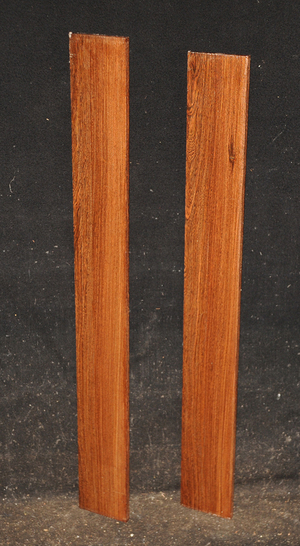
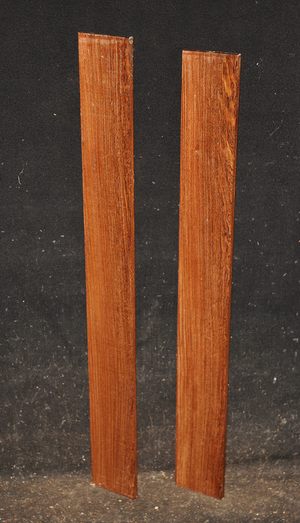
Brown Ebony Bass Guitar Finger Boards
Item Number: IW37437
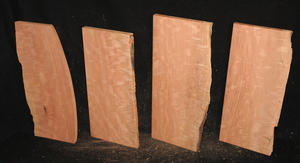
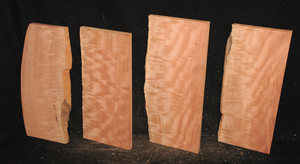
Figured European Pearwood Charcuterie Board Blanks
Pyrus communis
Almost all Pearwood imported into the U.S.A. has been steamed to bring out a more pinkish-red color and to prevent drying stresses. Formerly the wood was used for carving, turning, drawing instruments, wood engravings, textile printing blocks, and tool handles. Stained black it is an excellent substitute for Ebony. Contemporary uses include woodwinds such as recorders, furniture, kitchen accessories, jewelry and other boxes, and architectural uses such as paneling and doors.
These boards may have a few natural defects that were not trimmed off but are otherwise lovely pieces of wood. Surfaced on both faces and flat.
Item Number: W44061
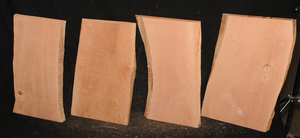
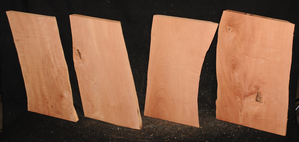
European Pearwood Charcuterie Board Blanks
Pyrus communis
Almost all Pearwood imported into the U.S.A. has been steamed to bring out a more pinkish-red color and to prevent drying stresses. Formerly the wood was used for carving, turning, drawing instruments, wood engravings, textile printing blocks, and tool handles. Stained black it is an excellent substitute for Ebony. Contemporary uses include woodwinds such as recorders, furniture, kitchen accessories, jewelry and other boxes, and architectural uses such as paneling and doors.
These boards may have a few natural defects that were not trimmed off but are otherwise lovely pieces of wood. Surfaced on both faces and flat.
Item Number: W44060

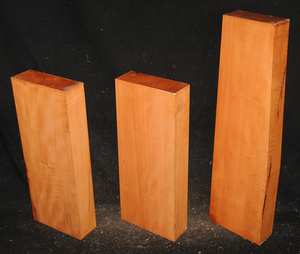
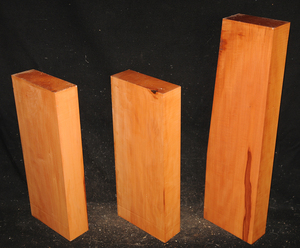
Figured European Pearwood
Pyrus communis
Almost all Pearwood imported into the U.S.A. has been steamed to bring out a more pinkish-red color and to prevent drying stresses. Formerly the wood was used for carving, turning, drawing instruments, wood engravings, textile printing blocks, and tool handles. Stained black it is an excellent substitute for Ebony. Contemporary uses include woodwinds such as recorders, furniture, kitchen accessories, jewelry and other boxes, and architectural uses such as paneling and doors.
Item Number: W44059
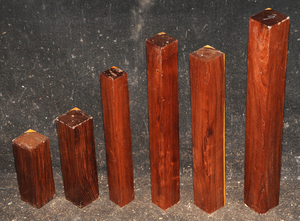
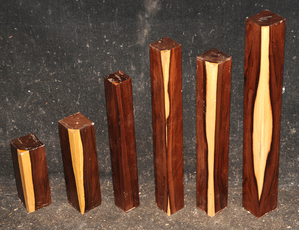
Cocuswood Turning Squares
Brya ebenus
This extremely rare species is found in Cuba, Jamaica, and the Dominican Republic. Also called Green, Brown, or West Indian Ebony. The heartwood is brownish-yellow to dark brown often with a greenish tinge. It is usually beautifully veined with darker streaks. The wood is hard and heavy weighing 68 to 80 lbs/cubic foot. This high density contributes to its wonderful acoustic properties-it fairly rings when struck. It is well known for its use in woodwinds such as flutes, piccolos, and bagpipes because of its fine and uniform grain, its beautiful coloring and its resonance.
Item Number: W44039
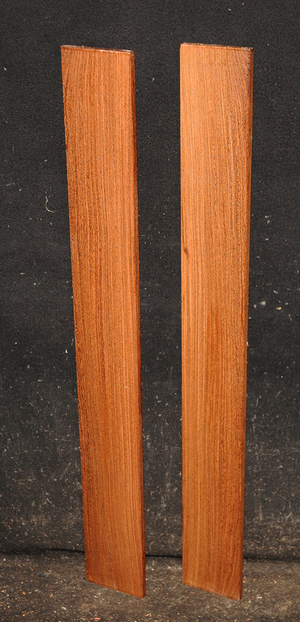
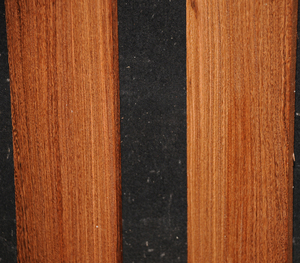
Brown Ebony Bass Guitar Finger Boards
Item Number: IW37395
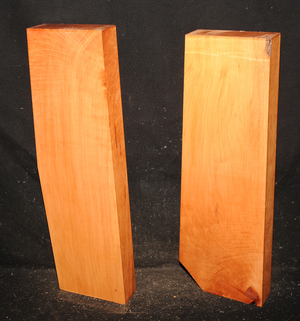
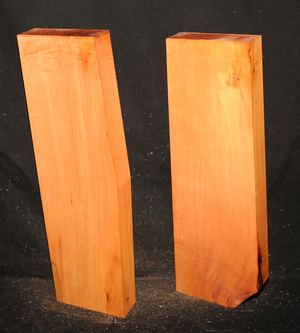
European Pearwood
Pyrus communis
Almost all Pearwood imported into the U.S.A. has been steamed to bring out a more pinkish-red color and to prevent drying stresses. Formerly the wood was used for carving, turning, drawing instruments, wood engravings, textile printing blocks, and tool handles. Stained black it is an excellent substitute for Ebony. Contemporary uses include woodwinds such as recorders, furniture, kitchen accessories, jewelry and other boxes, and architectural uses such as paneling and doors.
Item Number: W43996
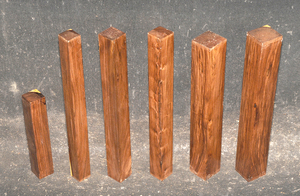
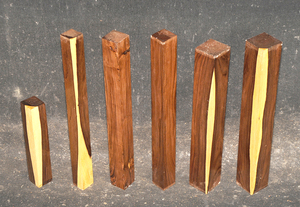
Cocuswood Turning Squares
Brya ebenus
This extremely rare species is found in Cuba, Jamaica, and the Dominican Republic. Also called Green, Brown, or West Indian Ebony. The heartwood is brownish-yellow to dark brown often with a greenish tinge. It is usually beautifully veined with darker streaks. The wood is hard and heavy weighing 68 to 80 lbs/cubic foot. This high density contributes to its wonderful acoustic properties-it fairly rings when struck. It is well known for its use in woodwinds such as flutes, piccolos, and bagpipes because of its fine and uniform grain, its beautiful coloring and its resonance.
C the actual length is 12 but we tallied it at 8 3/8 because of slight defects on one end.
F has a small defect on 2 corners that looks to go through the middle of the square.. You will for sure get 2 pieces that are clear that are 4 1/4" and 6 1/2" long. The actual length is 11 11/16". Priced according to the clear sections.
Item Number: W43609
Katalox
Swartzia cubensis
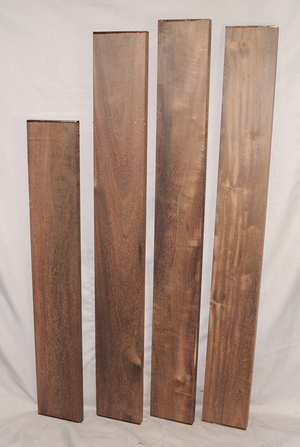
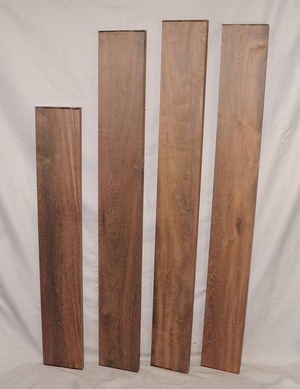
This is a large tree 2-4' diameter, by up to 120' tall from Mexico & Central America. The wood is very dense and fairly fine-grained. Because of its hardness it can be difficult to work but it takes a fine polish. Its dark color leads some to call it Mexican Ebano and very dark pieces can be used as a substitute for true black Ebony, especially in laminations and inlays. Straight-grained wood can be used for musical instrument fingerboards and bridge blanks.
Item Number: W43607
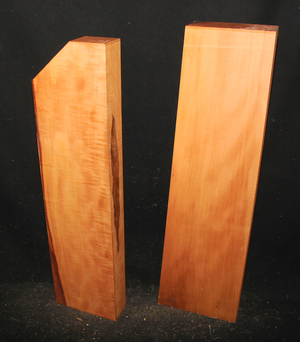
Figured European Pearwood
Pyrus communis
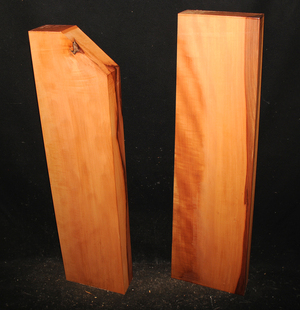
Almost all Pearwood imported into the U.S.A. has been steamed to bring out a more pinkish-red color and to prevent drying stresses. Formerly the wood was used for carving, turning, drawing instruments, wood engravings, textile printing blocks, and tool handles. Stained black it is an excellent substitute for Ebony. Contemporary uses include woodwinds such as recorders, furniture, kitchen accessories, jewelry and other boxes, and architectural uses such as paneling and doors.
These were all cut from 30 year old stock.
Item Number: W43584
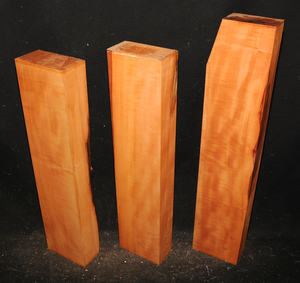
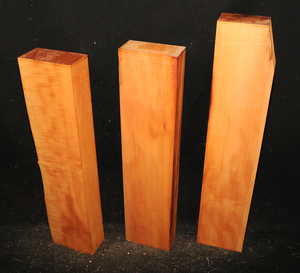
Figured European Pearwood
Pyrus communis
Almost all Pearwood imported into the U.S.A. has been steamed to bring out a more pinkish-red color and to prevent drying stresses. Formerly the wood was used for carving, turning, drawing instruments, wood engravings, textile printing blocks, and tool handles. Stained black it is an excellent substitute for Ebony. Contemporary uses include woodwinds such as recorders, furniture, kitchen accessories, jewelry and other boxes, and architectural uses such as paneling and doors.
These were all cut from 30 year old stock.
Item Number: W43583
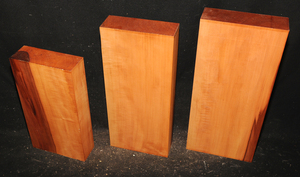
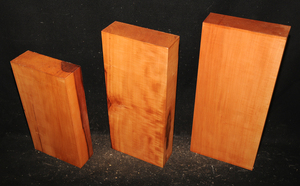
Figured European Pearwood
Pyrus communis
Almost all Pearwood imported into the U.S.A. has been steamed to bring out a more pinkish-red color and to prevent drying stresses. Formerly the wood was used for carving, turning, drawing instruments, wood engravings, textile printing blocks, and tool handles. Stained black it is an excellent substitute for Ebony. Contemporary uses include woodwinds such as recorders, furniture, kitchen accessories, jewelry and other boxes, and architectural uses such as paneling and doors.
These were all cut from 30 year old stock.
Item Number: W43582
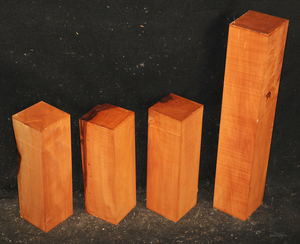
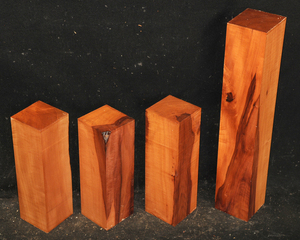
European Pearwood Turning Squares
Pyrus communis
Almost all Pearwood imported into the U.S.A. has been steamed to bring out a more pinkish-red color and to prevent drying stresses. Formerly the wood was used for carving, turning, drawing instruments, wood engravings, textile printing blocks, and tool handles. Stained black it is an excellent substitute for Ebony. Contemporary uses include woodwinds such as recorders, furniture, kitchen accessories, jewelry and other boxes, and architectural uses such as paneling and doors.
Item Number: W43563
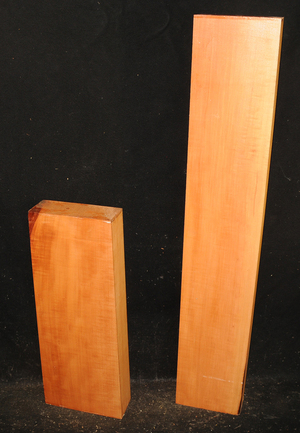
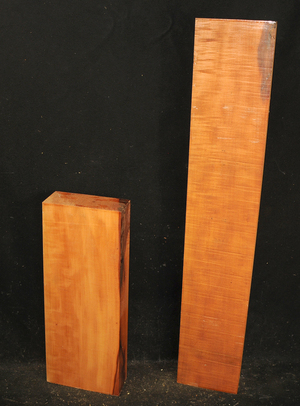
Figured European Pearwood Acoustic Guitar Set Billets
Pyrus communis
Almost all Pearwood imported into the U.S.A. has been steamed to bring out a more pinkish-red color and to prevent drying stresses. Formerly the wood was used for carving, turning, drawing instruments, wood engravings, textile printing blocks, and tool handles. Stained black it is an excellent substitute for Ebony. Contemporary uses include woodwinds such as recorders, furniture, kitchen accessories, jewelry and other boxes, and architectural uses such as paneling and doors.
Both of these are quartersawn and both cut from the same log.
Item Number: IW37146


Figured European Pearwood
Pyrus communis
Almost all Pearwood imported into the U.S.A. has been steamed to bring out a more pinkish-red color and to prevent drying stresses. Formerly the wood was used for carving, turning, drawing instruments, wood engravings, textile printing blocks, and tool handles. Stained black it is an excellent substitute for Ebony. Contemporary uses include woodwinds such as recorders, furniture, kitchen accessories, jewelry and other boxes, and architectural uses such as paneling and doors.
A has a corner cut off.
Item Number: W43297


Figured European Pearwood
Pyrus communis
Almost all Pearwood imported into the U.S.A. has been steamed to bring out a more pinkish-red color and to prevent drying stresses. Formerly the wood was used for carving, turning, drawing instruments, wood engravings, textile printing blocks, and tool handles. Stained black it is an excellent substitute for Ebony. Contemporary uses include woodwinds such as recorders, furniture, kitchen accessories, jewelry and other boxes, and architectural uses such as paneling and doors.
A has some wane on one corner.
B has a little wane on one corner.
Item Number: W43296


Figured European Pearwood
Pyrus communis
Almost all Pearwood imported into the U.S.A. has been steamed to bring out a more pinkish-red color and to prevent drying stresses. Formerly the wood was used for carving, turning, drawing instruments, wood engravings, textile printing blocks, and tool handles. Stained black it is an excellent substitute for Ebony. Contemporary uses include woodwinds such as recorders, furniture, kitchen accessories, jewelry and other boxes, and architectural uses such as paneling and doors.
B and C a little wane on one corner.
Item Number: W43295

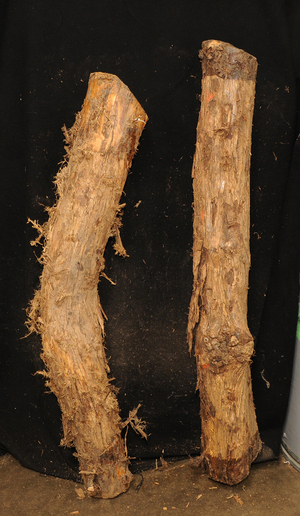


Cocuswood Logs
Brya ebenus
This extremely rare species is found in Cuba, Jamaica, and the Dominican Republic. Also called Green, Brown, or West Indian Ebony. The heartwood is brownish-yellow to dark brown often with a greenish tinge. It is usually beautifully veined with darker streaks. The wood is hard and heavy weighing 68 to 80 lbs/cubic foot. This high density contributes to its wonderful acoustic properties-it fairly rings when struck. It is well known for its use in woodwinds such as flutes, piccolos, and bagpipes because of its fine and uniform grain, its beautiful coloring and its resonance.
These logs do have a lot of defects as seen in the photos. When we mill these logs, we do get some nice squares, but it is tricky work cutting around all the cracks. If you have any questions, please don't hesitate to call or email.
Item Number: W43247


Cocuswood Logs
Brya ebenus
This extremely rare species is found in Cuba, Jamaica, and the Dominican Republic. Also called Green, Brown, or West Indian Ebony. The heartwood is brownish-yellow to dark brown often with a greenish tinge. It is usually beautifully veined with darker streaks. The wood is hard and heavy weighing 68 to 80 lbs/cubic foot. This high density contributes to its wonderful acoustic properties-it fairly rings when struck. It is well known for its use in woodwinds such as flutes, piccolos, and bagpipes because of its fine and uniform grain, its beautiful coloring and its resonance.
These logs do have a lot of defects as seen in the photos. When we mill these logs, we do get some nice squares, but it is tricky work cutting around all the cracks. If you have any questions, please don't hesitate to call or email.
Item Number: W43246


Figured European Pearwood
Pyrus communis
Almost all Pearwood imported into the U.S.A. has been steamed to bring out a more pinkish-red color and to prevent drying stresses. Formerly the wood was used for carving, turning, drawing instruments, wood engravings, textile printing blocks, and tool handles. Stained black it is an excellent substitute for Ebony. Contemporary uses include woodwinds such as recorders, furniture, kitchen accessories, jewelry and other boxes, and architectural uses such as paneling and doors.
Item Number: W42964


European Pearwood
Pyrus communis
Almost all Pearwood imported into the U.S.A. has been steamed to bring out a more pinkish-red color and to prevent drying stresses. Formerly the wood was used for carving, turning, drawing instruments, wood engravings, textile printing blocks, and tool handles. Stained black it is an excellent substitute for Ebony. Contemporary uses include woodwinds such as recorders, furniture, kitchen accessories, jewelry and other boxes, and architectural uses such as paneling and doors.
These both have a little wane on one corner.
Item Number: W42951


European Pearwood
Pyrus communis
Almost all Pearwood imported into the U.S.A. has been steamed to bring out a more pinkish-red color and to prevent drying stresses. Formerly the wood was used for carving, turning, drawing instruments, wood engravings, textile printing blocks, and tool handles. Stained black it is an excellent substitute for Ebony. Contemporary uses include woodwinds such as recorders, furniture, kitchen accessories, jewelry and other boxes, and architectural uses such as paneling and doors.
C has a few defects that haven't been fully milled off. A lot of very usable material still. Priced accordingly.
Item Number: W42950


Cocuswood Turning Squares
Brya ebenus
This extremely rare species is found in Cuba, Jamaica, and the Dominican Republic. Also called Green, Brown, or West Indian Ebony. The heartwood is brownish-yellow to dark brown often with a greenish tinge. It is usually beautifully veined with darker streaks. The wood is hard and heavy weighing 68 to 80 lbs/cubic foot. This high density contributes to its wonderful acoustic properties-it fairly rings when struck. It is well known for its use in woodwinds such as flutes, piccolos, and bagpipes because of its fine and uniform grain, its beautiful coloring and its resonance.
E has a little wane on one end, should turn off. This piece also has the remnants of cracks we milled off, which means the cracks end at the surface of the square. You can see where they were but they don't go into the piece any farther.
Item Number: W42820


Katalox
Swartzia cubensis
This is a large tree 2-4' diameter, by up to 120' tall from Mexico & Central America. The wood is very dense and fairly fine-grained. Because of its hardness it can be difficult to work but it takes a fine polish. Its dark color leads some to call it Mexican Ebano and very dark pieces can be used as a substitute for true black Ebony, especially in laminations and inlays. Straight-grained wood can be used for musical instrument fingerboards and bridge blanks.
Item Number: W42805


European Pearwood
Pyrus communis
Almost all Pearwood imported into the U.S.A. has been steamed to bring out a more pinkish-red color and to prevent drying stresses. Formerly the wood was used for carving, turning, drawing instruments, wood engravings, textile printing blocks, and tool handles. Stained black it is an excellent substitute for Ebony. Contemporary uses include woodwinds such as recorders, furniture, kitchen accessories, jewelry and other boxes, and architectural uses such as paneling and doors.
Item Number: W42802


West African Ebony Pen Blank Bundles
Acer saccharum
The heartwood is white or cream to light brown or reddish brown. Figured somewhat like that of burl with many small eyes separate from each other. Hard and heavy, 45 lbs/cu ft. Easy to work and takes a smooth polish. U.S.A.
6 pieces each.
Item Number: W39279