
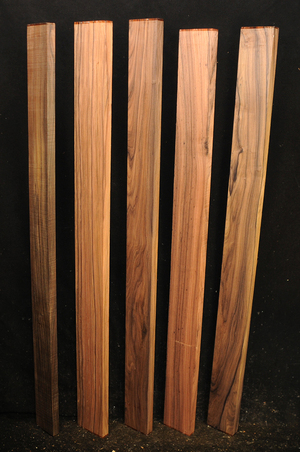
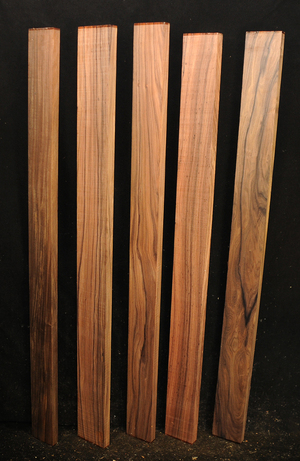
Santos Rosewood
Machaerium sp.
This wood has gained in popularity since the early 1990's when Brazilian Rosewood was designated an endangered species. Furniture manufacturers used it as a Brazilian Rosewood substitute but it stands on its own as an instrument tone wood.
Item Number: W43821

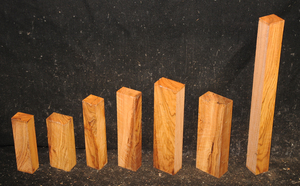
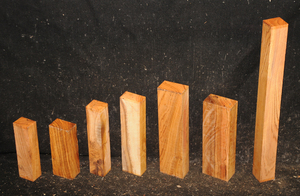
Wild African Olivewood
Olea macrocarpa
A species of Olive from South Africa. Very rarely seen on the commercial timber market. It is similar in color to the European species but is denser and harder with more variegations of color and grain. Partially air-dried.
Item Number: W43818
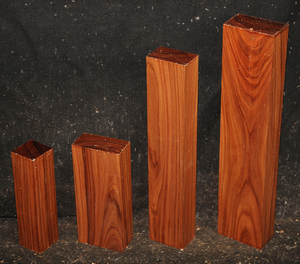
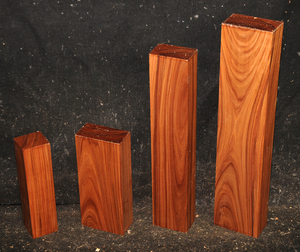
Pau Ferro
Machaerium sp.
This wood has gained in popularity since the early 1990's when Brazilian Rosewood was designated an endangered species. Furniture manufacturers used it as a Brazilian Rosewood substitute but it stands on its own as an instrument tone wood.
Item Number: W43817
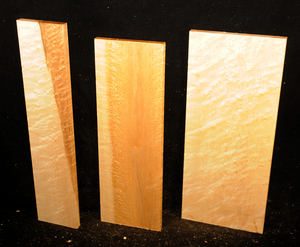
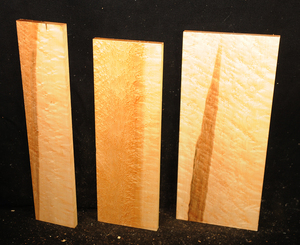
Bird's-eye Maple
Acer saccharum
The heartwood is white or cream to light brown or reddish brown. Figured somewhat like that of burl with many small eyes separate from each other. Hard and heavy, 45 lbs/cu ft. Easy to work and takes a smooth polish. U.S.A.
Item Number: W43815
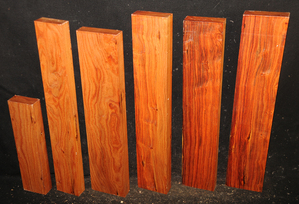
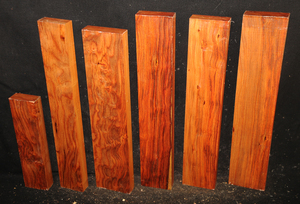
Pau Rosa
Swartzia fistuloides
Hard & heavy & capable of a beautiful polish. Rare on the American market. Partially air dried.
Item Number: W43814
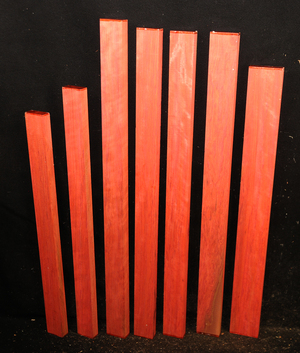
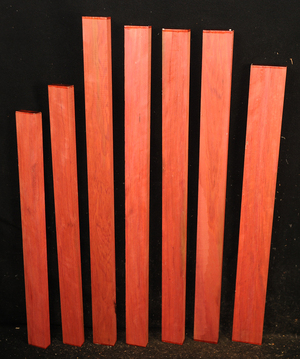
Chakte-kok
Cosmocalyx spectabilis
This species is from the Yucatan Peninsula of Mexico. It is also called Redheart. Freshly cut it is a brilliant red color which darkens on exposure.
Item Number: W43810
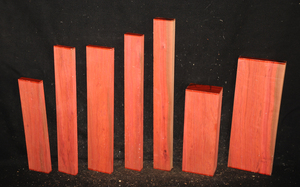
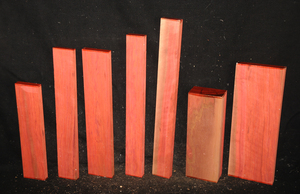
Chakte-kok
Cosmocalyx spectabilis
This species is from the Yucatan Peninsula of Mexico. It is also called Redheart. Freshly cut it is a brilliant red color which darkens on exposure.
Item Number: W43809
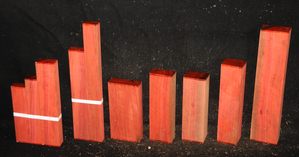
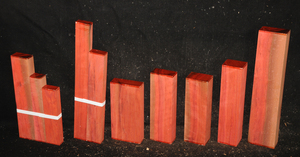
Chakte-kok Bundles & Blocks
Cosmocalyx spectabilis
This species is from the Yucatan Peninsula of Mexico. It is also called Redheart. Freshly cut it is a brilliant red color which darkens on exposure.
A has 3 pieces.
B has 2 pieces.
Item Number: W43806
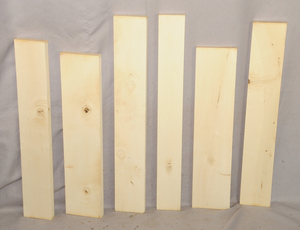
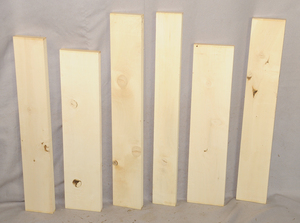
American Holly
Ilex opaca
Holly is the whitest wood commercially available. Our stock was cut during the winter and quickly dried in a vacuum kiln to prevent discoloration. The result is very white wood without gray or bluish staining. The wood is fine-grained and is excellent for turnery, inlays, musical instrument edge bandings, etc. The grade is common and better which means that there can be some defects, mainly knots.
Item Number: W43802
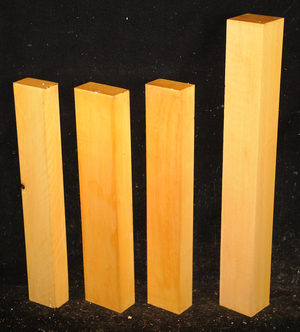
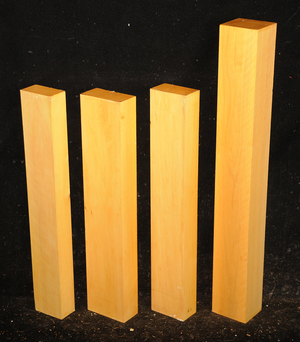
Castello Boxwood
Calycophyllum multiflorum
Castello Boxwood, though not a true Buxus species, still has a very fine texture and a lovely light canary yellow color. This is truly a dream wood to mill.It is an excellent turnery wood, capable of very fine detail. Also very popular for making scale timbers and other parts for model ships. Air-dried.
Item Number: W43801
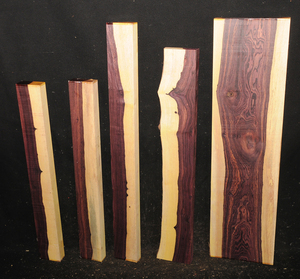
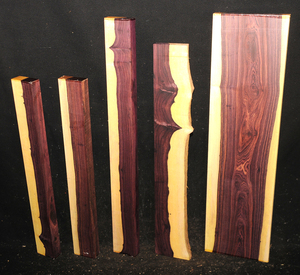
Camatillo
Dalbergia congestiflora
Also called Para Kingwood & Mexican Kingwood. The deep purple heartwood is oily and takes an incredible polish with a smoothness pleasing to the fingertips.
Due to CITES regulations, we can only ship this species to customers in the United States.
Item Number: W43798
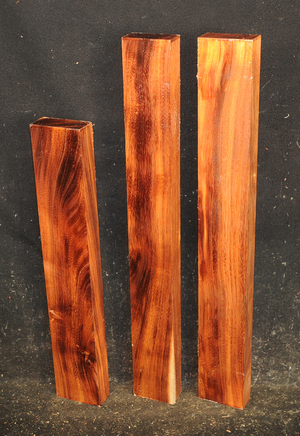
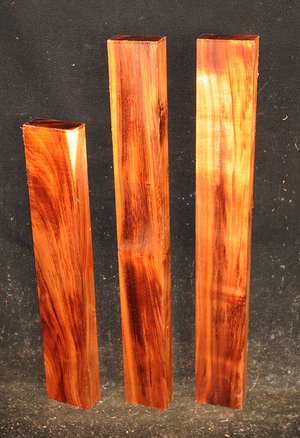
Hawaiian Koa
Acacia Koa
This species is found almost exclusively in the Hawaiian Islands. It ranges in color from a pale brown to a reddish brown to a very dark, almost chocolate brown. It has a texture similar to Walnut but is easier to work. Can be highly chatoyant or lustrous. Highly sought after for use in musical instruments, especially guitars and ukuleles. Koa is becoming rare.
Item Number: W43796
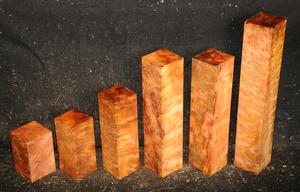
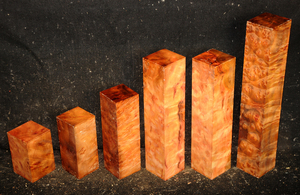
Camphor Burl Turning Squares
Cinnamomum sp.
This rare burl is from S.E. Asia and is seldom seen on the world market. It is fine-grained and varies in color from a light reddish-brown to almost scarlet. It is easy to work and has a very pungent, spicy scent. For a burl it is remarkably stable. Green to partially air dried.
Item Number: W43788
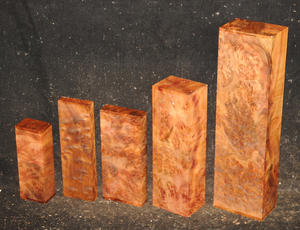
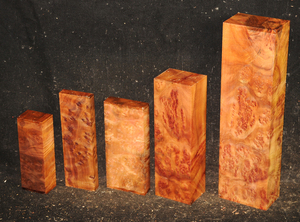
Camphor Burl
Cinnamomum sp.
This rare burl is from S.E. Asia and is seldom seen on the world market. It is fine-grained and varies in color from a light reddish-brown to almost scarlet. It is easy to work and has a very pungent, spicy scent. For a burl it is remarkably stable. Green to partially air dried.
Item Number: W43782
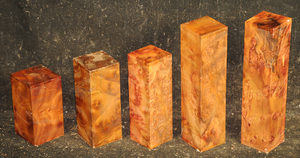
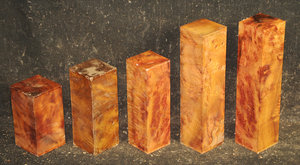
Camphor Burl Turning Squares
Cinnamomum sp.
This rare burl is from S.E. Asia and is seldom seen on the world market. It is fine-grained and varies in color from a light reddish-brown to almost scarlet. It is easy to work and has a very pungent, spicy scent. For a burl it is remarkably stable. Green to partially air dried.
Item Number: W43779
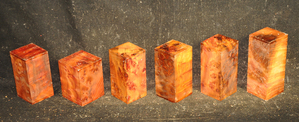
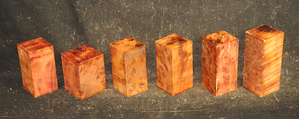
Camphor Burl Turning Squares
Cinnamomum sp.
This rare burl is from S.E. Asia and is seldom seen on the world market. It is fine-grained and varies in color from a light reddish-brown to almost scarlet. It is easy to work and has a very pungent, spicy scent. For a burl it is remarkably stable. Green to partially air dried.
Item Number: W43778
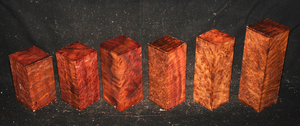
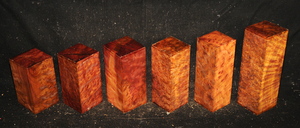
Camphor Burl Turning Squares
Cinnamomum sp.
This rare burl is from S.E. Asia and is seldom seen on the world market. It is fine-grained and varies in color from a light reddish-brown to almost scarlet. It is easy to work and has a very pungent, spicy scent. For a burl it is remarkably stable. Green to partially air dried.
Item Number: W43771
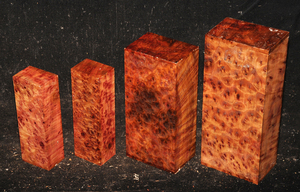
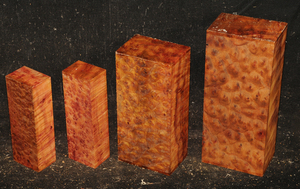
Camphor Burl
Cinnamomum sp.
This rare burl is from S.E. Asia and is seldom seen on the world market. It is fine-grained and varies in color from a light reddish-brown to almost scarlet. It is easy to work and has a very pungent, spicy scent. For a burl it is remarkably stable. Green to partially air dried.
Item Number: W43770
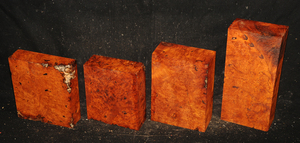
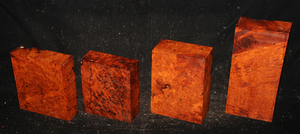
Makamong Burl
Afzelia xylocarpa
This is from S.E. Asia and is also called Makamong. We cut a large burl years ago into 4" to 6" slabs. The burl was old to begin with, and had been lying in a timber brokers yard for who knows how long. But it was long enough for pests to burrow through the sapwood and into a bit of the heartwood. The effects were incredible. It reminds me of an old dolomite cave complex after thousands of years of water erosion. Full of fissures and chasms, it is easy to visualize bats flying in and out or maybe a miniature version of Shelob's lair.
Item Number: W43764
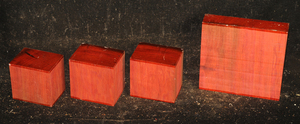
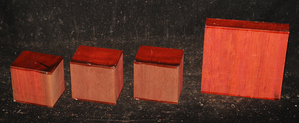
Chakte-kok Bowl Blanks
Cosmocalyx spectabilis
This species is from the Yucatan Peninsula of Mexico. It is also called Redheart. Freshly cut it is a brilliant red color which darkens on exposure.
Item Number: W43763
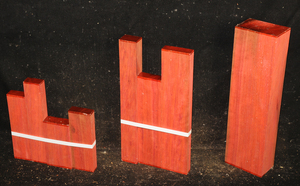
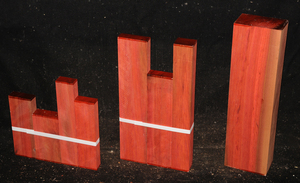
Chakte-kok Bundles & Block
Cosmocalyx spectabilis
This species is from the Yucatan Peninsula of Mexico. It is also called Redheart. Freshly cut it is a brilliant red color which darkens on exposure.
A has 4 pieces.
B has 3 pieces.
Item Number: W43762
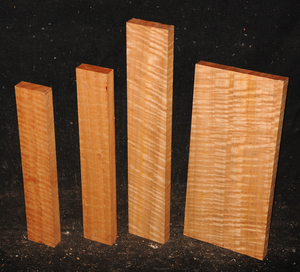
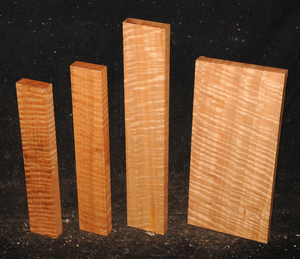
Figured Eucalyptus
Item Number: W43758
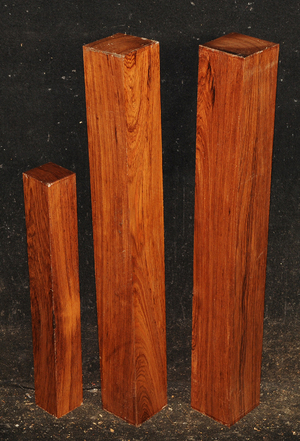
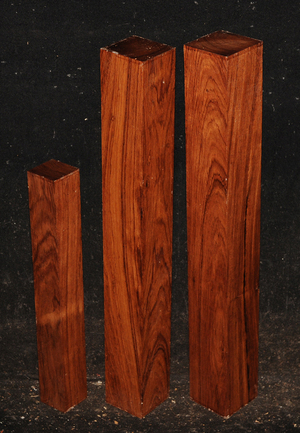
Honduras Rosewood Turning Squares
Dalbergia stevensonii
A true rosewood, most of our stock comes from Belize. Smelling like stored apples, it is a lovely wood to turn and takes a fantastic polish. Getting scarce on the world market.
Due to CITES regulations, we can only ship this species to customers in the United States.
Item Number: W43757
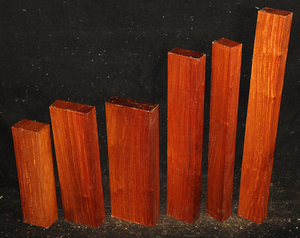
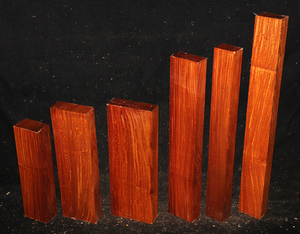
Figured Narra
Pterocarpus indicus
Also called New Guinea Rosewood. It is a beautiful, highly lustrous golden yellow color sometimes with reddish streaks. A nice turning wood it is also used in furniture, jewelry boxes, handles, etc. It is easy to work and glue and takes a nice polish.
Item Number: W43756
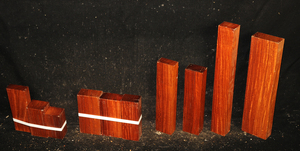
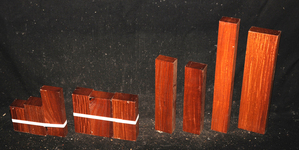
Figured Narra Bundles & Blocks
Pterocarpus indicus
Also called New Guinea Rosewood. It is a beautiful, highly lustrous golden yellow color sometimes with reddish streaks. A nice turning wood it is also used in furniture, jewelry boxes, handles, etc. It is easy to work and glue and takes a nice polish.
The bundles have 3 pieces each.
Item Number: W43755
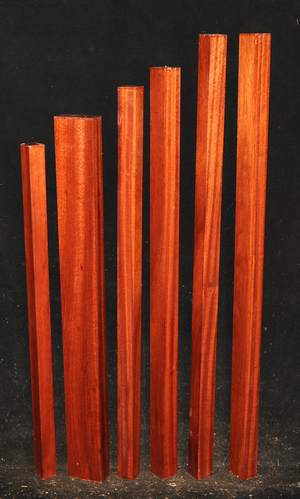
Bloodwood
Brosimum paraense
Also called Satine, Cacique, and Cardinalwood. The heartwood is a rich strawberry red, in sharp contrast to the light colored sapwood. Takes a high, lustrous finish.
Item Number: W43750
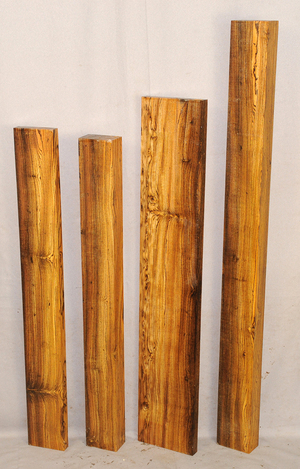
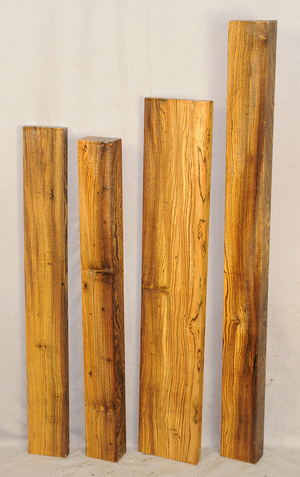
Mexican Bocote
Cordia elaeagnoides
Bocote is an oily wood with a yellowish to dark brown color accented with irregular black stripes and streaks. It has a spicy smell and is hard, heavy and strong. It is easy to work and takes a very nice polish. This beautiful wood is seldom seen in woodworker's shops.
Item Number: W43743
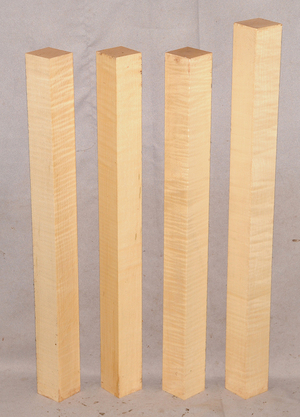
Curly European Sycamore Turning Squares
Acer pseudoplatanus
This European Maple is native to central Europe and west Asia. It is a tough, white or cream colored, fine-grained timber. It reminds me of vanilla ice cream because it is so even-colored. It works well in any grain direction. It is used for musical instruments, furniture, cabinetry, and because it is non-staining it is used for kitchen utensils, wooden spoons, rolling pins, and cutting boards. The figure is fiddleback on the quartersawn surface and more of a broken curl on the flatsawn surface. Select, quartersawn material is used for violin backs and sides and necks. Dry.
Item Number: W43741
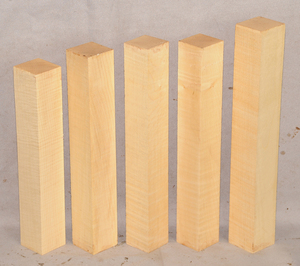
Curly European Sycamore Turning Squares
Acer pseudoplatanus
This European Maple is native to central Europe and west Asia. It is a tough, white or cream colored, fine-grained timber. It reminds me of vanilla ice cream because it is so even-colored. It works well in any grain direction. It is used for musical instruments, furniture, cabinetry, and because it is non-staining it is used for kitchen utensils, wooden spoons, rolling pins, and cutting boards. The figure is fiddleback on the quartersawn surface and more of a broken curl on the flatsawn surface. Select, quartersawn material is used for violin backs and sides and necks. Dry.
Item Number: W43740
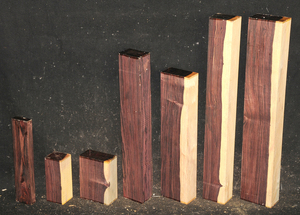
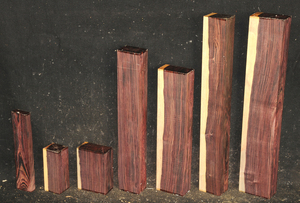
Camatillo
Dalbergia congestiflora
Also called Para Kingwood & Mexican Kingwood. The deep purple heartwood is oily and takes an incredible polish with a smoothness pleasing to the fingertips.
Due to CITES regulations, we can only ship this species to customers in the United States.
Item Number: W43739
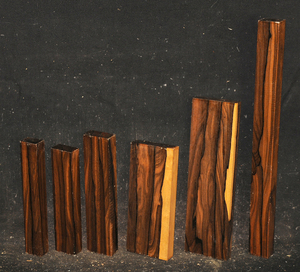
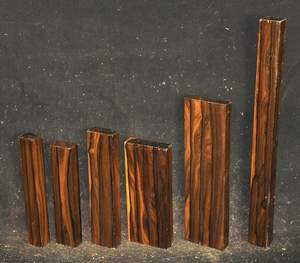
Ziricote
Cordia dodecandra
Ziricote is another timber we get from the Yucatan Peninsula of Mexico. It is a lovely wood with a very pronounced ray fleck on radial surfaces sometimes producing a "landscape" effect much like picture jasper.
Item Number: W43737
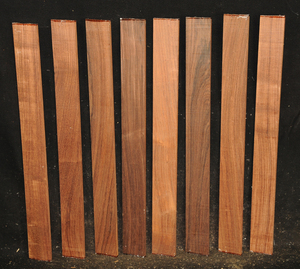
Amazon Rosewood Thins
Dalbergia spruceana
This is a fairly rare species from the Amazon region of Brazil. The heartwood varies from a golden-brown to a reddish-brown often with narrow, dark stripes. It is hard and heavy, but easy to work, and takes a high polish.
Due to CITES regulations, we can only ship this species to customers in the United States.
Item Number: W43736
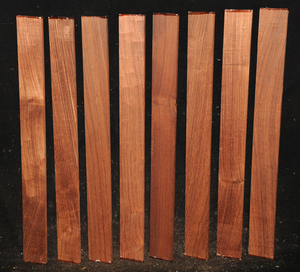
Amazon Rosewood Thins
Dalbergia spruceana
This is a fairly rare species from the Amazon region of Brazil. The heartwood varies from a golden-brown to a reddish-brown often with narrow, dark stripes. It is hard and heavy, but easy to work, and takes a high polish.
Due to CITES regulations, we can only ship this species to customers in the United States.
Item Number: W43735
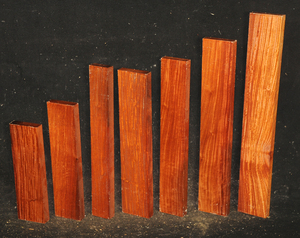
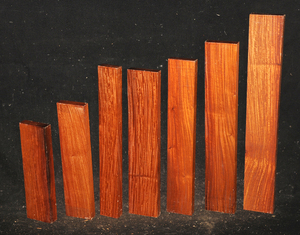
Figured Narra
Pterocarpus indicus
Also called New Guinea Rosewood. It is a beautiful, highly lustrous golden yellow color sometimes with reddish streaks. A nice turning wood it is also used in furniture, jewelry boxes, handles, etc. It is easy to work and glue and takes a nice polish.
Item Number: W43732
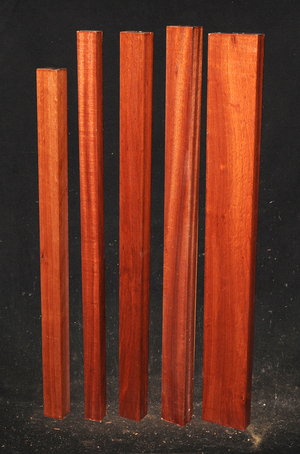
Brazilian Bloodwood
Brosimum paraense
Also called Satine, Cacique, and Cardinalwood. The heartwood is a rich strawberry red, in sharp contrast to the light colored sapwood. Takes a high, lustrous finish.
Item Number: W43730
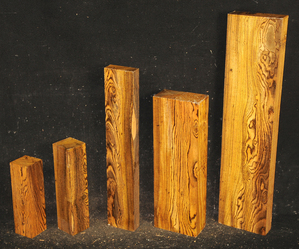
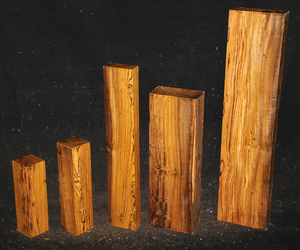
Mexican Bocote
Cordia elaeagnoides
Bocote is an oily wood with a yellowish to dark brown color accented with irregular black stripes and streaks. It has a spicy smell and is hard, heavy and strong. It is easy to work and takes a very nice polish. This beautiful wood is seldom seen in woodworker's shops.
Item Number: W43725
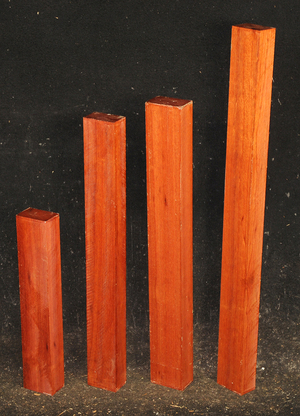
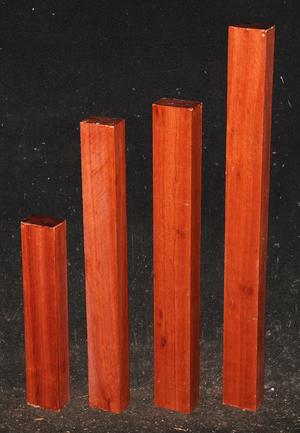
Bloodwood
Brosimum paraense
Also called Satine, Cacique, and Cardinalwood. The heartwood is a rich strawberry red, in sharp contrast to the light colored sapwood. Takes a high, lustrous finish.
Item Number: W43724
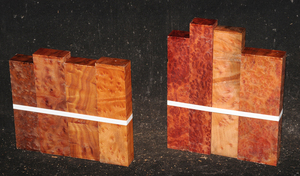
Camphor Burl Bundles
Cinnamomum sp.
This rare burl is from S.E. Asia and is seldom seen on the world market. It is fine-grained and varies in color from a light reddish-brown to almost scarlet. It is easy to work and has a very pungent, spicy scent. For a burl it is remarkably stable. Green to partially air dried.
Both bundles have 4 pieces each.
Item Number: W43720
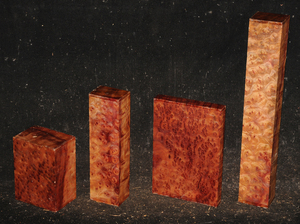
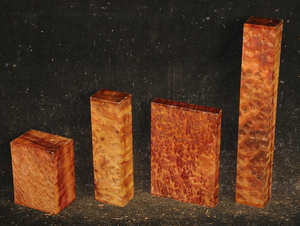
Camphor Burl
Cinnamomum sp.
This rare burl is from S.E. Asia and is seldom seen on the world market. It is fine-grained and varies in color from a light reddish-brown to almost scarlet. It is easy to work and has a very pungent, spicy scent. For a burl it is remarkably stable. Green to partially air dried.
Item Number: W43713

Gift Certifcate
If you would like to buy a Gift Certificate to Gilmer Wood Company for a friend or loved one, here is how to go about it:
Add any of the below items to your cart totally to the desired amount of the gift certificate. For example, if you wanted a gift certificate totally $125.00, you would add one B ($50.00) and one C ($75.00) to your cart.
Click on the "shopping cart" text at the top of the screen, then click on the green "check out" button.
Fill in where you would like the gift certificate sent to in the shipping fields and the billing address for your credit card in the billing fields. We're happy to send the gift certificate directly to the recipient or to you to give to them in person.
In the notes section, please write out any message you would like included on the gift certificate itself. Expand the image of the example gift certificate for an idea of what the final gift certificate will look like.
After you click on the "verify order" button, please review all the information you have input and then click the "submit order" button to finalize your gift certificate purchase.
We physically mail all of our gift certificates out and we will do our best to get your gift certificate in the mail as soon as we can.
You are also welcome to give us a call at 503-274-1271 and buy a gift certificate over the phone.
Item Number: OS103
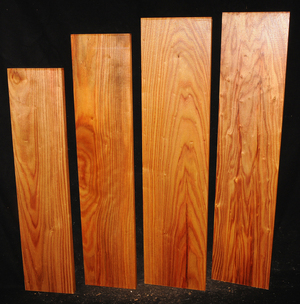
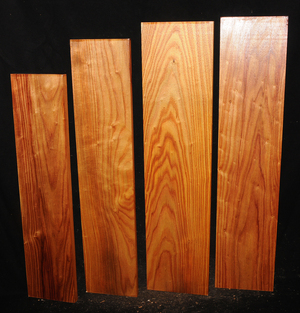
Canarywood
Centrolobium paraense
This Brazilian hardwood is occasionally seen to have the bright, brilliantly hued colors as found in these boards. It has medium density and is easy to work and finish.
Item Number: W43702
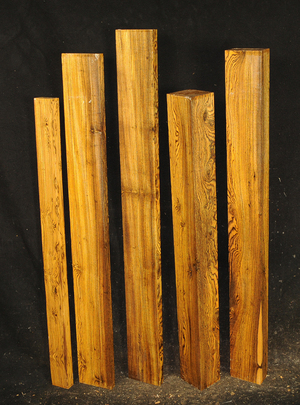
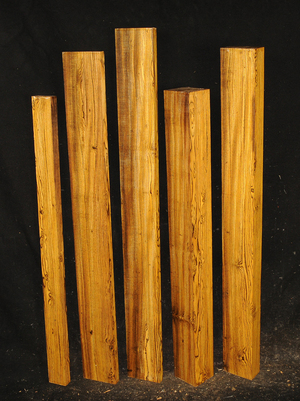
Mexican Bocote
Cordia elaeagnoides
Bocote is an oily wood with a yellowish to dark brown color accented with irregular black stripes and streaks. It has a spicy smell and is hard, heavy and strong. It is easy to work and takes a very nice polish. This beautiful wood is seldom seen in woodworker's shops.
Item Number: W43701
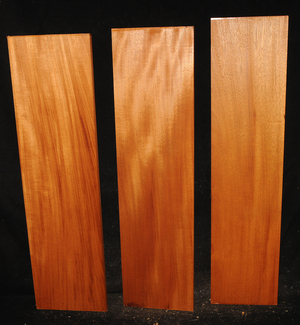
Genuine Mahogany
Swietenia macrophylla
Also called Acajou, Tropical American Mahogany, and Honduras Mahogany. This medium to large tree occurs throughout Central and South America. Related to Cuban Mahogany (Swietenia mahogani) and Pacific Coast Mahogany (Swietenia humilis). It produces one of the classic furniture and cabinetmaking woods. The heartwood varies from a light reddish-brown to a rich, dark red. Generally straight grained and exceptionally stable, it is easy to machine, hand plane, sand and finish. Occasional logs produce several figures, curly, quilted, and the rare plum pudding figure which looks like large drips running down the board. Used in fine furniture and joinery, boat building, and in the guitar industry for acoustic sets and necks.
Due to CITES regulations, we can only ship this species to customers in the United States.
Item Number: W43696
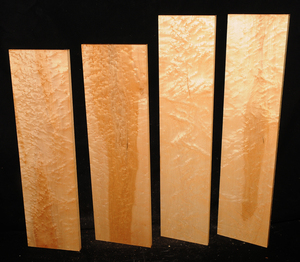
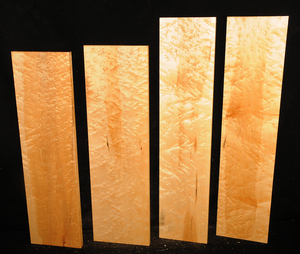
Bird's-eye Maple
Acer saccharum
The heartwood is white or cream to light brown or reddish brown. Figured somewhat like that of burl with many small eyes separate from each other. Hard and heavy, 45 lbs/cu ft. Easy to work and takes a smooth polish. U.S.A.
Item Number: W43692
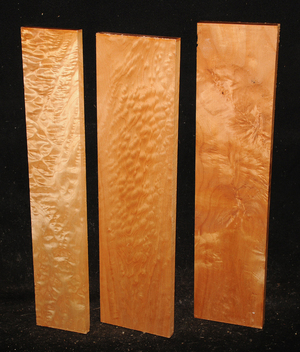
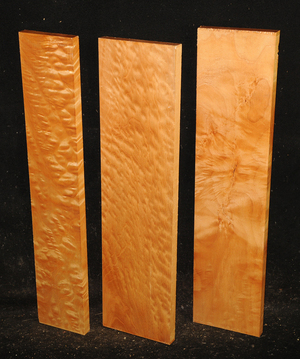
Quilted & Figured Big Leaf Maple
Acer macrophyllum
This tree is native to the Pacific Northwest. It has the distinction of having the largest leaf of the Maples-up to 15" in diameter. This is a soft Maple. The tree can produce many different types of figure, including quilted (tubular, popcorn, & cloud), curly (fiddleback, broken, & basketweave), and burl.
Item Number: W43678
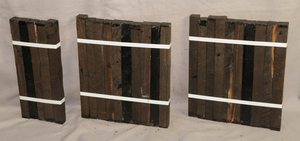
Malagasy Ebony Turning Squares Bundles
Diospyros perreiri
This Ebony is unsurpassed for its beauty and blackness. It is fairly fine-textured and takes a high polish. Finest ebony in the world. Rare.
This species is on the CITES list and as a consequence, we are limiting sales to the United States only.
A has 5 pieces
B & C has 10 pieces each.
Item Number: W43675
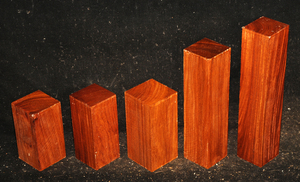
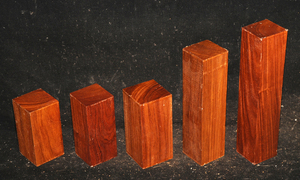
Narra Turning Squares
Pterocarpus indicus
Also called New Guinea Rosewood. It is a beautiful, highly lustrous golden yellow color sometimes with reddish streaks. A nice turning wood it is also used in furniture, jewelry boxes, handles, etc. It is easy to work and glue and takes a nice polish.
Item Number: W43667
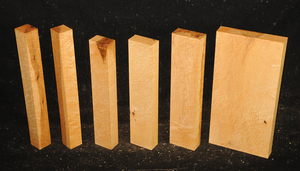
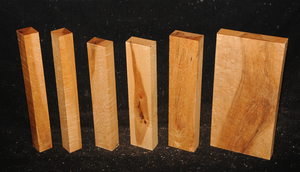
Bird's-eye Maple
Acer saccharum
The heartwood is white or cream to light brown or reddish brown. Figured somewhat like that of burl with many small eyes separate from each other. Hard and heavy, 45 lbs/cu ft. Easy to work and takes a smooth polish. U.S.A.
Item Number: W43665
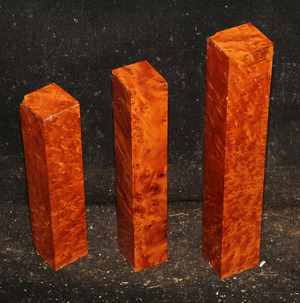
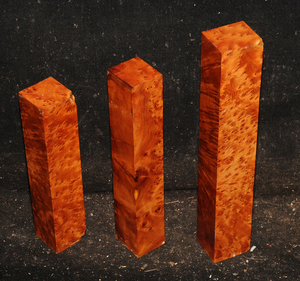
Thuya Burl
Tetraclinis articulata
This comes from the Atlas mountains in Morocco and has a beautiful golden chatoyance. Its color varies from a rich, lustrous golden brown to nearly black. Thuya burl is hard and dense with a high oil content, but tends to be brittle. The eyes, perfectly round, are scattered about in some burls like the figure in bird's-eye maple; in others they are grouped as islands. Due to it's desert occurrence, the wood sometimes contains small defects or inclusions but most can be repaired with cyanoacrylate (super) glues. A rare species, this exquisite wood is used for inlays, small boxes, turnery, and precious objects.
Item Number: W43664
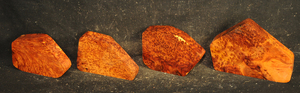

Thuya Burl
Tetraclinis articulata
This comes from the Atlas mountains in Morocco and has a beautiful golden chatoyance. Its color varies from a rich, lustrous golden brown to nearly black. Thuya burl is hard and dense with a high oil content, but tends to be brittle. The eyes, perfectly round, are scattered about in some burls like the figure in bird's-eye maple; in others they are grouped as islands. Due to it's desert occurrence, the wood sometimes contains small defects or inclusions but most can be repaired with cyanoacrylate (super) glues. A rare species, this exquisite wood is used for inlays, small boxes, turnery, and precious objects.
Item Number: W43663