
Wild Olivewood
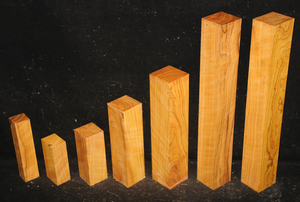
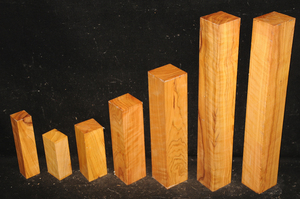
Olea macrocarpa
A species of Olive from South Africa. Very rarely seen on the commercial timber market. It is similar in color to the European species but is denser and harder with more variegations of color and grain. Partially air-dried.
F has some small checks on the corner which will turn off.
Item Number: W44394

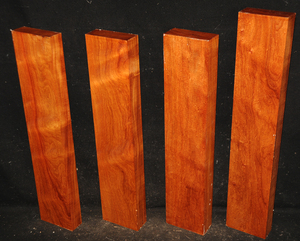
Narra
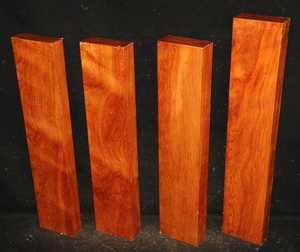
Pterocarpus indicus
Also called New Guinea Rosewood. It is a beautiful, highly lustrous golden yellow color sometimes with reddish streaks. A nice turning wood it is also used in furniture, jewelry boxes, handles, etc. It is easy to work and glue and takes a nice polish.
These have some figure on the edge.
Item Number: W44393
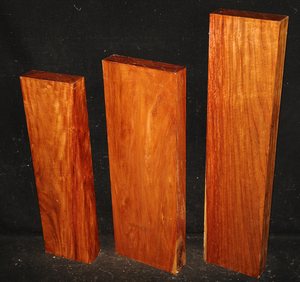
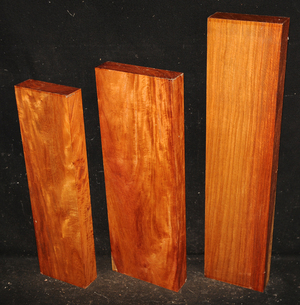
Figured Narra
Pterocarpus indicus
Also called New Guinea Rosewood. It is a beautiful, highly lustrous golden yellow color sometimes with reddish streaks. A nice turning wood it is also used in furniture, jewelry boxes, handles, etc. It is easy to work and glue and takes a nice polish.
Item Number: W44392
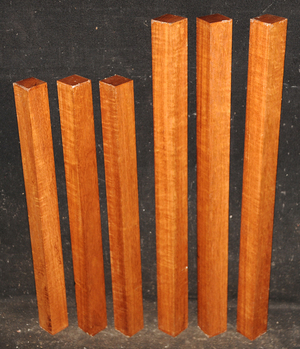
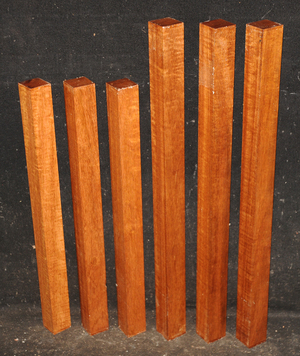
Figured Knobthorn Acacia Turning Squares
Acacia nigrescens
This South African tree is noted for its bark which has prominent knobby prickles. The heartwood is medium to dark brown and close grained. It is hard and heavy and takes a nice polish. Rare on the American market.
Item Number: W44390
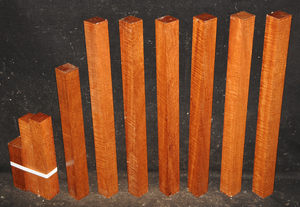
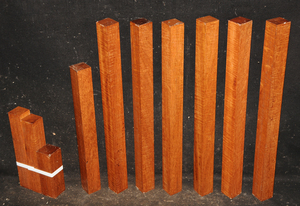
Figured Knobthorn Acacia Bundle & Turning Squares
Acacia nigrescens
This South African tree is noted for its bark which has prominent knobby prickles. The heartwood is medium to dark brown and close grained. It is hard and heavy and takes a nice polish. Rare on the American market.
A has 3 pieces.
Item Number: W44389
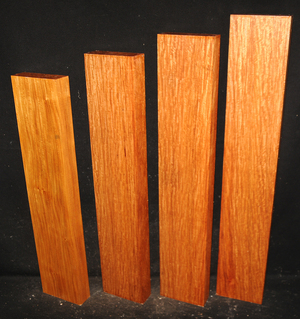
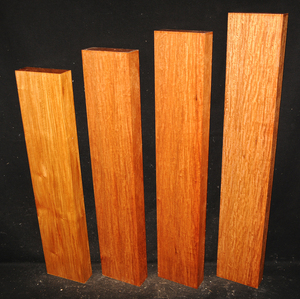
Figured Narra
Pterocarpus indicus
Also called New Guinea Rosewood. It is a beautiful, highly lustrous golden yellow color sometimes with reddish streaks. A nice turning wood it is also used in furniture, jewelry boxes, handles, etc. It is easy to work and glue and takes a nice polish.
A has a little less figure than the other 3 pieces, but is still quite nice.
Item Number: W44388
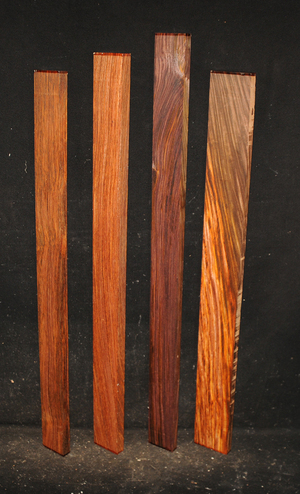
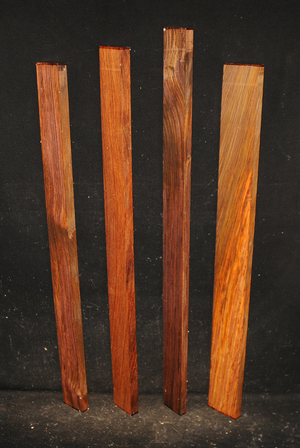
Mexican Cocobolo
Dalbergia retusa
The wood is very oily which makes it difficult to glue but on the plus side the oiliness makes it easy to produce a fantastic polish on finished pieces. Wear a respirator mask when working Cocobolo as the dust can produce asthma-like reactions. Cocobolo is a small to medium sized tree and is found mainly in Mexico, Costa Rica, Nicaragua, and Panama.
Due to CITES regulations, we can only ship this species to customers in the United States.
Item Number: W44387
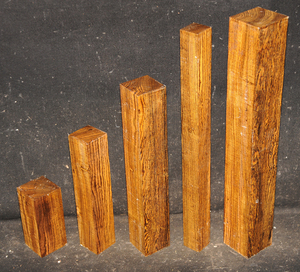
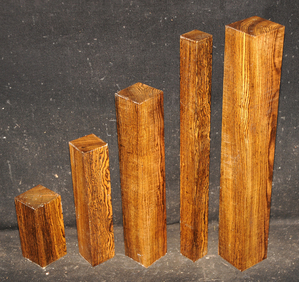
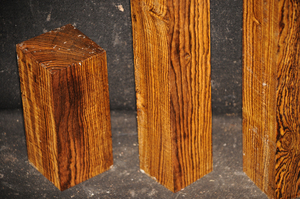
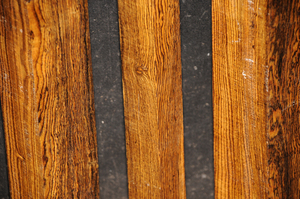
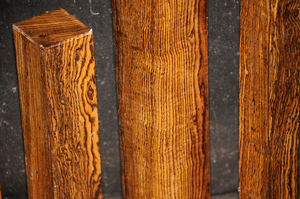
Curly Mexican Bocote Turning Squares
Cordia elaeagnoides
Bocote is an oily wood with a yellowish to dark brown color accented with irregular black stripes and streaks. It has a spicy smell and is hard, heavy and strong. It is easy to work and takes a very nice polish. This beautiful wood is seldom seen in woodworker's shops.
These all have a curly figure, which is extremely rare in this species. It shows up as a very tight, fiddleback figute on the quartersawn faces. The figure can be subtle but still very cool looking .
Item Number: W44384
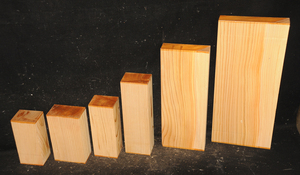
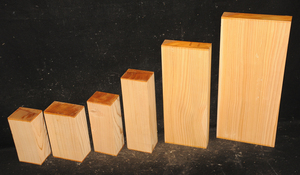
Lebanese Cedar
Cedrus libani
This is one of the true Cedars. There are more than 50 references to Lebanese Cedar in the Bible. Psalms 92:12-"The righteous shall flourish like the palm tree: he shall grow like a Cedar of Lebanon". Because of its durability the Egyptians used it for making mummy cases. Carvings of Cedar have been unearthed in ancient tombs still in excellent condition. These boards are from a tree grown as an ornamental in England. The wood has a crisp texture and a lovely, aromatic scent that is very long lasting.
Item Number: W44382
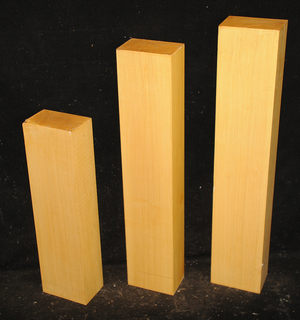
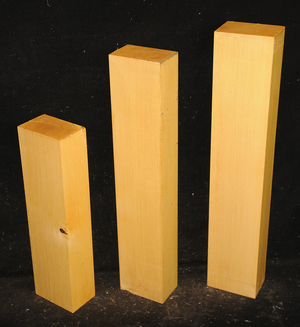
Castello Boxwood
Calycophyllum multiflorum
Castello Boxwood, though not a true Buxus species, still has a very fine texture and a lovely light canary yellow color. This is truly a dream wood to mill.It is an excellent turnery wood, capable of very fine detail. Also very popular for making scale timbers and other parts for model ships. Air-dried.
Item Number: W44381
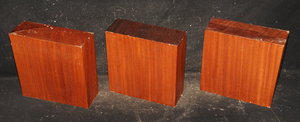
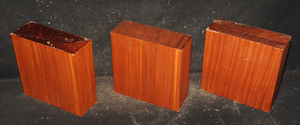
Ribbon Striped Sapele Bowl Blanks
Entandrophragma cylindricum
The Sapele tree is found in tropical West & Central Africa. Even when without figure as this board Sapele has an amazing luster and takes a beautiful polish.
Item Number: W44379
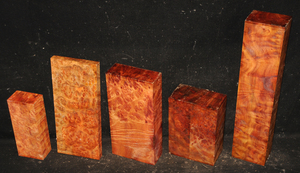
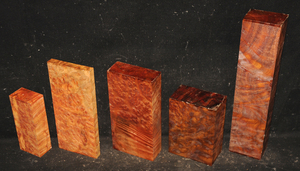
Camphor Burl
Cinnamomum sp.
This rare burl is from S.E. Asia and is seldom seen on the world market. It is fine-grained and varies in color from a light reddish-brown to almost scarlet. It is easy to work and has a very pungent, spicy scent. For a burl it is remarkably stable. Green to partially air dried.
Item Number: W44373
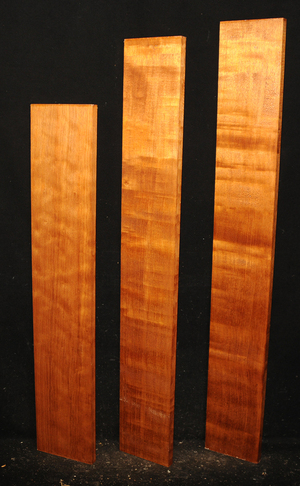
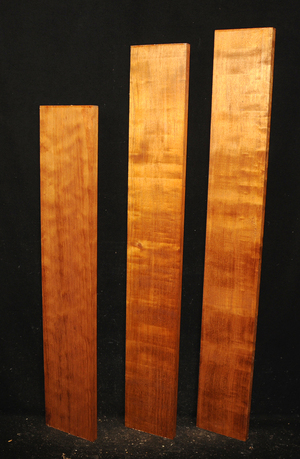
Figured Genuine Mahogany
Swietenia macrophylla
Also called Acajou, Tropical American Mahogany, and Honduras Mahogany. This medium to large tree occurs throughout Central and South America. Related to Cuban Mahogany (Swietenia mahogani) and Pacific Coast Mahogany (Swietenia humilis). It produces one of the classic furniture and cabinetmaking woods. The heartwood varies from a light reddish-brown to a rich, dark red. Generally straight grained and exceptionally stable, it is easy to machine, hand plane, sand and finish. Occasional logs produce several figures, curly, quilted, and the rare plum pudding figure which looks like large drips running down the board. Used in fine furniture and joinery, boat building, and in the guitar industry for acoustic sets and necks.
Due to CITES regulations, we can only ship this species to customers in the United States.
Item Number: W44371
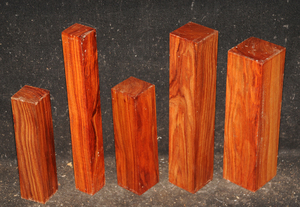
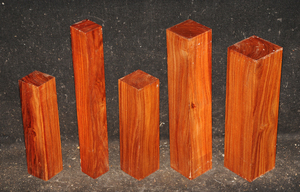
Pau Rosa Turning Squares
Swartzia fistuloides
Hard & heavy & capable of a beautiful polish. Rare on the American market. Partially air dried.
Item Number: W44370
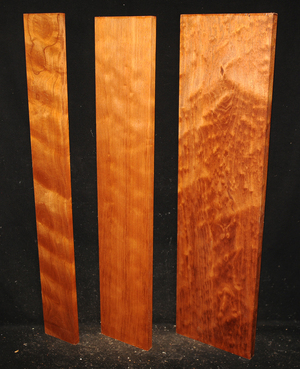
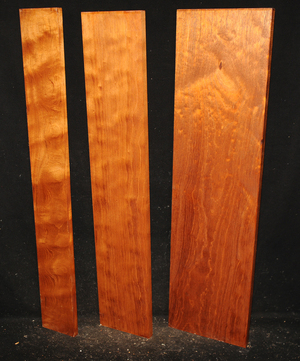
Figured Genuine Mahogany
Swietenia macrophylla
Also called Acajou, Tropical American Mahogany, and Honduras Mahogany. This medium to large tree occurs throughout Central and South America. Related to Cuban Mahogany (Swietenia mahogani) and Pacific Coast Mahogany (Swietenia humilis). It produces one of the classic furniture and cabinetmaking woods. The heartwood varies from a light reddish-brown to a rich, dark red. Generally straight grained and exceptionally stable, it is easy to machine, hand plane, sand and finish. Occasional logs produce several figures, curly, quilted, and the rare plum pudding figure which looks like large drips running down the board. Used in fine furniture and joinery, boat building, and in the guitar industry for acoustic sets and necks.
Due to CITES regulations, we can only ship this species to customers in the United States.
Item Number: W44366
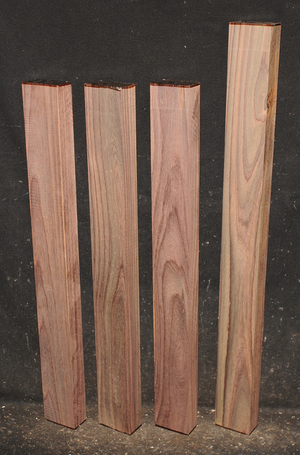
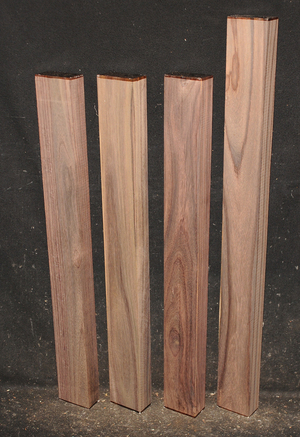
East Indian Rosewood
Dalbergia latifolia
This is grown on plantations in Indonesia where it is called Sonokeling. These came from a tree large enough and old enough to look much like the old-growth lumber from India.
Due to CITES regulations, we can only ship this species to customers in the United States.
Item Number: W44365
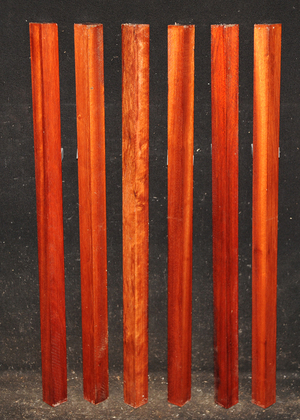
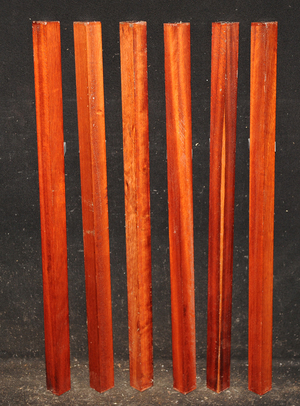
Brazilian Bloodwood Turning Squares/Pool Cue Blanks
Brosimum paraense
Also called Satine, Cacique, and Cardinalwood. The heartwood is a rich strawberry red, in sharp contrast to the light colored sapwood. Takes a high, lustrous finish.
Item Number: W44364
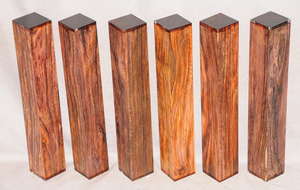
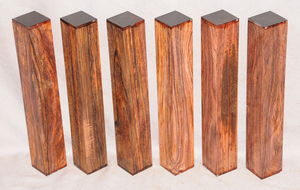
Mexican Cocobolo Turning Squares
Dalbergia retusa
The wood is very oily which makes it difficult to glue but on the plus side the oiliness makes it easy to produce a fantastic polish on finished pieces. Wear a respirator mask when working Cocobolo as the dust can produce asthma-like reactions. Cocobolo is a small to medium sized tree and is found mainly in Mexico, Costa Rica, Nicaragua, and Panama.
Due to CITES regulations, we can only ship this species to customers in the United States.
Item Number: W44363
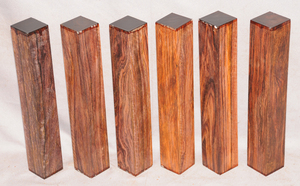
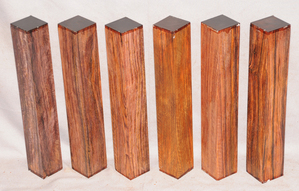
Mexican Cocobolo Turning Squares
Dalbergia retusa
The wood is very oily which makes it difficult to glue but on the plus side the oiliness makes it easy to produce a fantastic polish on finished pieces. Wear a respirator mask when working Cocobolo as the dust can produce asthma-like reactions. Cocobolo is a small to medium sized tree and is found mainly in Mexico, Costa Rica, Nicaragua, and Panama.
Due to CITES regulations, we can only ship this species to customers in the United States.
Item Number: W44362
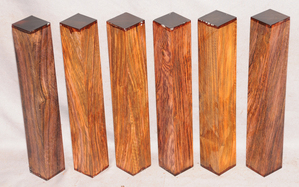
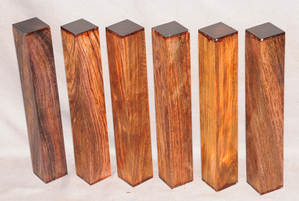
Mexican Cocobolo Turning Squares
Dalbergia retusa
The wood is very oily which makes it difficult to glue but on the plus side the oiliness makes it easy to produce a fantastic polish on finished pieces. Wear a respirator mask when working Cocobolo as the dust can produce asthma-like reactions. Cocobolo is a small to medium sized tree and is found mainly in Mexico, Costa Rica, Nicaragua, and Panama.
Due to CITES regulations, we can only ship this species to customers in the United States.
Item Number: W44361
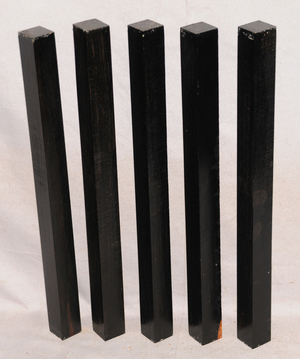
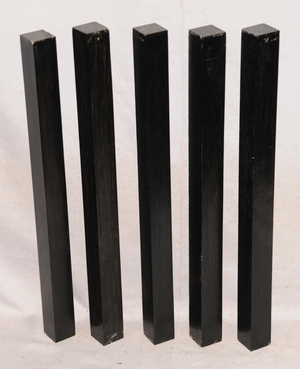
West African Ebony Turning Squares
Diospyros crassiflora
Sometimes called Gabon or Gaboon, this Ebony is sometimes jet black but oftentimes has grayish streaks that mostly disappear when finished or after the made object has been put into service. This Ebony has a marked resistance to checking that is characteristic of some of the Indian and Asian species. It has a wonderful texture and is easily carved, planed, turned, and milled. It is fairly fine-grained and takes a high polish. This Ebony usually originates in either Cameroon or Nigeria and the logs are rough hewn in the forest and oftentimes brought to the nearest road by human porters. With the disappearance of other species of black Ebony this species is fast becoming the Ebony of choice.
Item Number: W44360
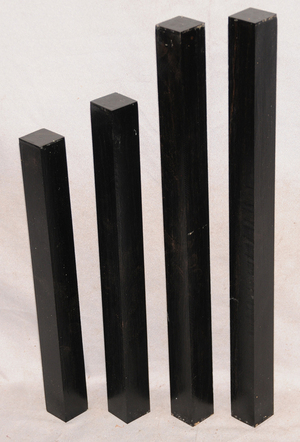
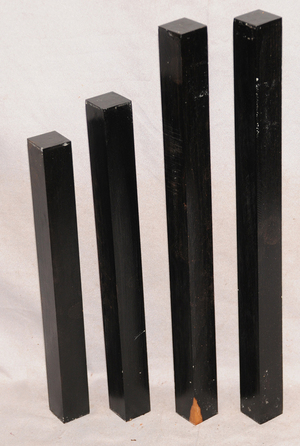
West African Ebony Turning Squares
Diospyros crassiflora
Sometimes called Gabon or Gaboon, this Ebony is sometimes jet black but oftentimes has grayish streaks that mostly disappear when finished or after the made object has been put into service. This Ebony has a marked resistance to checking that is characteristic of some of the Indian and Asian species. It has a wonderful texture and is easily carved, planed, turned, and milled. It is fairly fine-grained and takes a high polish. This Ebony usually originates in either Cameroon or Nigeria and the logs are rough hewn in the forest and oftentimes brought to the nearest road by human porters. With the disappearance of other species of black Ebony this species is fast becoming the Ebony of choice.
Item Number: W44359
West African Ebony Turning Squares
Diospyros crassiflora
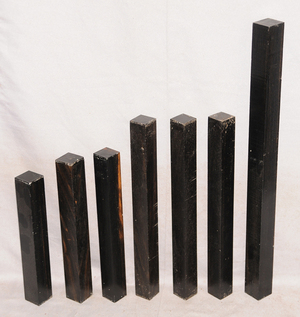
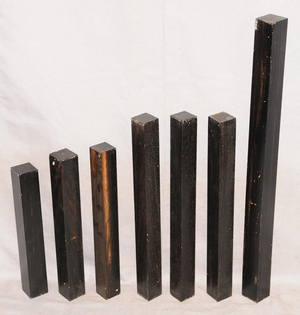
Sometimes called Gabon or Gaboon, this Ebony is sometimes jet black but oftentimes has grayish streaks that mostly disappear when finished or after the made object has been put into service. This Ebony has a marked resistance to checking that is characteristic of some of the Indian and Asian species. It has a wonderful texture and is easily carved, planed, turned, and milled. It is fairly fine-grained and takes a high polish. This Ebony usually originates in either Cameroon or Nigeria and the logs are rough hewn in the forest and oftentimes brought to the nearest road by human porters. With the disappearance of other species of black Ebony this species is fast becoming the Ebony of choice.
Item Number: W44358
West African Ebony Turning Squares
Diospyros crassiflora
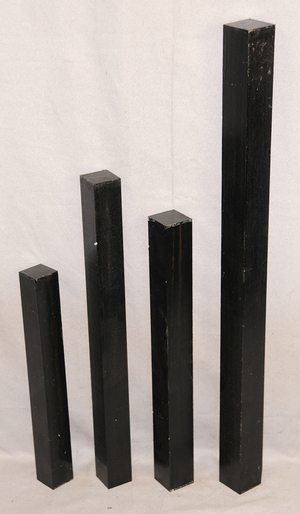
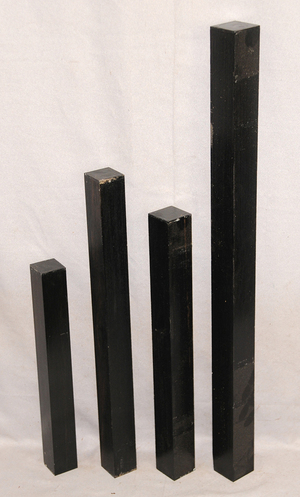
Sometimes called Gabon or Gaboon, this Ebony is sometimes jet black but oftentimes has grayish streaks that mostly disappear when finished or after the made object has been put into service. This Ebony has a marked resistance to checking that is characteristic of some of the Indian and Asian species. It has a wonderful texture and is easily carved, planed, turned, and milled. It is fairly fine-grained and takes a high polish. This Ebony usually originates in either Cameroon or Nigeria and the logs are rough hewn in the forest and oftentimes brought to the nearest road by human porters. With the disappearance of other species of black Ebony this species is fast becoming the Ebony of choice.
Item Number: W44357
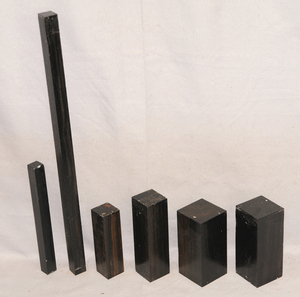
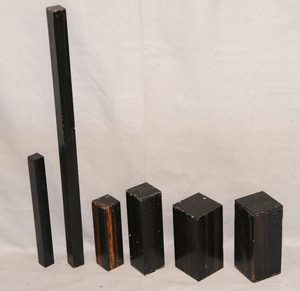
West African Ebony Turning Squares
Diospyros crassiflora
Sometimes called Gabon or Gaboon, this Ebony is sometimes jet black but oftentimes has grayish streaks that mostly disappear when finished or after the made object has been put into service. This Ebony has a marked resistance to checking that is characteristic of some of the Indian and Asian species. It has a wonderful texture and is easily carved, planed, turned, and milled. It is fairly fine-grained and takes a high polish. This Ebony usually originates in either Cameroon or Nigeria and the logs are rough hewn in the forest and oftentimes brought to the nearest road by human porters. With the disappearance of other species of black Ebony this species is fast becoming the Ebony of choice.
Item Number: W44356
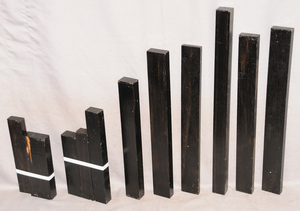
West African Ebony Bundles & Boards
Diospyros crassiflora
Sometimes called Gabon or Gaboon, this Ebony is sometimes jet black but oftentimes has grayish streaks that mostly disappear when finished or after the made object has been put into service. This Ebony has a marked resistance to checking that is characteristic of some of the Indian and Asian species. It has a wonderful texture and is easily carved, planed, turned, and milled. It is fairly fine-grained and takes a high polish. This Ebony usually originates in either Cameroon or Nigeria and the logs are rough hewn in the forest and oftentimes brought to the nearest road by human porters. With the disappearance of other species of black Ebony this species is fast becoming the Ebony of choice.
A has 2 pieces.
B has 3 pieces.
Item Number: W44355
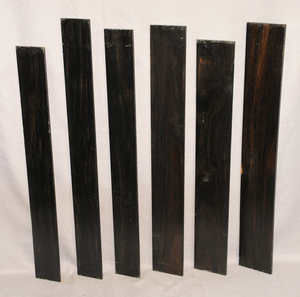
West African Ebony Thins
Diospyros crassiflora
Sometimes called Gabon or Gaboon, this Ebony is sometimes jet black but oftentimes has grayish streaks that mostly disappear when finished or after the made object has been put into service. This Ebony has a marked resistance to checking that is characteristic of some of the Indian and Asian species. It has a wonderful texture and is easily carved, planed, turned, and milled. It is fairly fine-grained and takes a high polish. This Ebony usually originates in either Cameroon or Nigeria and the logs are rough hewn in the forest and oftentimes brought to the nearest road by human porters. With the disappearance of other species of black Ebony this species is fast becoming the Ebony of choice.
Item Number: W44354
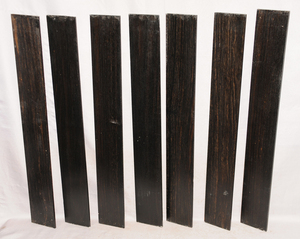
West African Ebony Thins
Diospyros crassiflora
Sometimes called Gabon or Gaboon, this Ebony is sometimes jet black but oftentimes has grayish streaks that mostly disappear when finished or after the made object has been put into service. This Ebony has a marked resistance to checking that is characteristic of some of the Indian and Asian species. It has a wonderful texture and is easily carved, planed, turned, and milled. It is fairly fine-grained and takes a high polish. This Ebony usually originates in either Cameroon or Nigeria and the logs are rough hewn in the forest and oftentimes brought to the nearest road by human porters. With the disappearance of other species of black Ebony this species is fast becoming the Ebony of choice.
Item Number: W44352
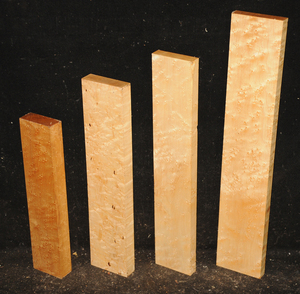
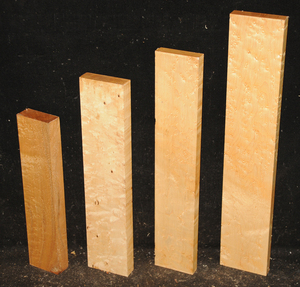
Bird's-eye Maple
Acer saccharum
The heartwood is white or cream to light brown or reddish brown. Figured somewhat like that of burl with many small eyes separate from each other. Hard and heavy, 45 lbs/cu ft. Easy to work and takes a smooth polish. U.S.A.
Item Number: W44348
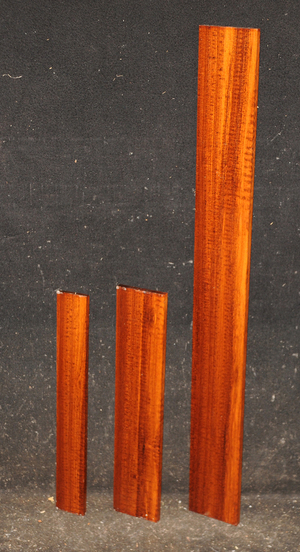
Snakewood Thins
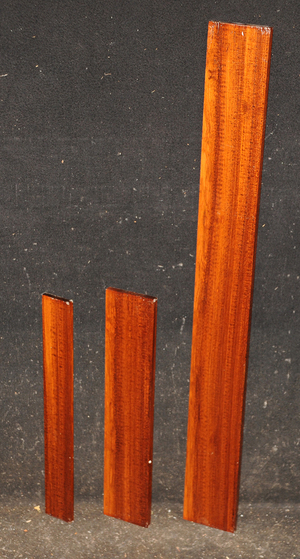
Piratinera guianensis
Also called Letterwood and Leopardwood. Color: dark red to reddish brown with irregular black speckles or stripes. Fine textured and highly lustrous. Very hard and heavy, 75-84 lbs/cu ft. Takes a beautiful finish. Very rare and very expensive. Guyana and Surinam.
A has a small crack at one end/edge. It is actually 1 15/16" wide but we tallied off the defect.
Item Number: W44345
Katalox
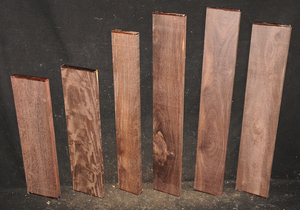
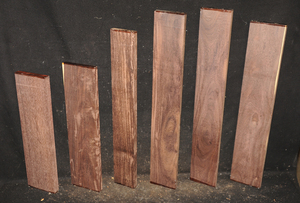
Swartzia cubensis
This is a large tree 2-4' diameter, by up to 120' tall from Mexico & Central America. The wood is very dense and fairly fine-grained. Because of its hardness it can be difficult to work but it takes a fine polish. Its dark color leads some to call it Mexican Ebano and very dark pieces can be used as a substitute for true black Ebony, especially in laminations and inlays. Straight-grained wood can be used for musical instrument fingerboards and bridge blanks.
B is figured.
Item Number: W44337
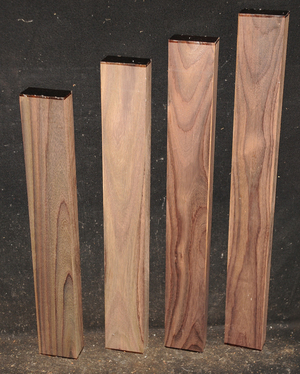
East Indian Rosewood
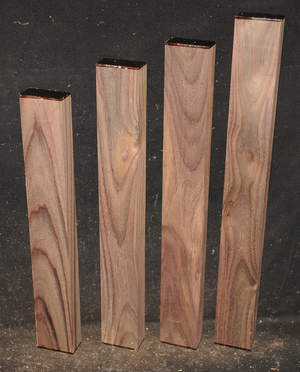
Dalbergia latifolia
This is grown on plantations in Indonesia where it is called Sonokeling. These came from a tree large enough and old enough to look much like the old-growth lumber from India.
Due to CITES regulations, we can only ship this species to customers in the United States.
Item Number: W44336
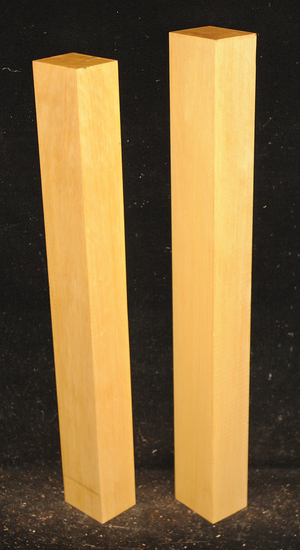
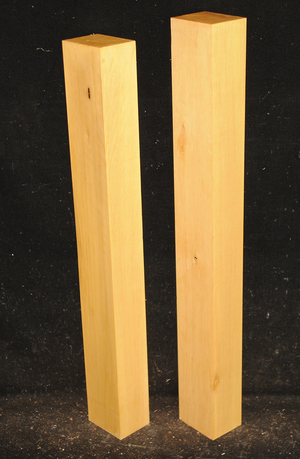
Castello Boxwood
Calycophyllum multiflorum
Castello Boxwood, though not a true Buxus species, still has a very fine texture and a lovely light canary yellow color. This is truly a dream wood to mill.It is an excellent turnery wood, capable of very fine detail. Also very popular for making scale timbers and other parts for model ships. Air-dried.
Item Number: W44331
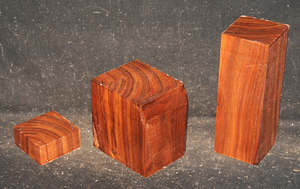
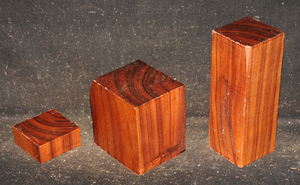
Hawaiian Koa Turning Blanks
Acacia Koa
This species is found almost exclusively in the Hawaiian Islands. It ranges in color from a pale brown to a reddish brown to a very dark, almost chocolate brown. It has a texture similar to Walnut but is easier to work. Can be highly chatoyant or lustrous. Highly sought after for use in musical instruments, especially guitars and ukuleles. Koa is becoming rare.
B has a little corner that some some bug damage.
C has a small area on one face that is a little punky, though it doesn't appear to go in very far.
Item Number: W44330
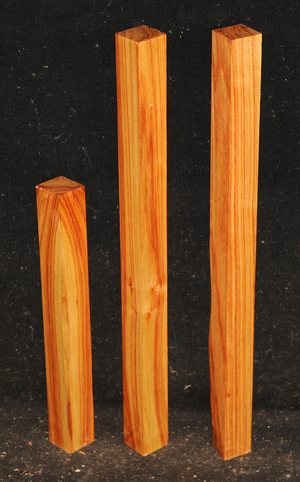
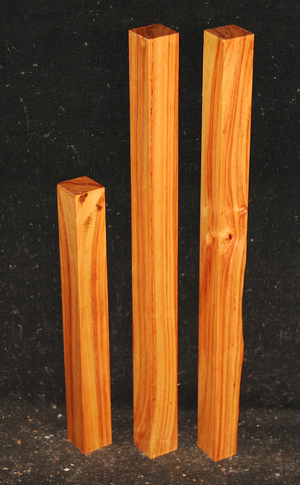
Brazilian Tulipwood Turning Squares/Pool Cue Blanks
Dalbergia decipularis
This beautiful member of the Rosewood family is getting scarce on the world's market. Traditionally used for decorative furniture bandings and inlays. When worked it has a delicate, sweet aroma. Takes a high polish.
Due to CITES regulations, we can only ship this species to customers in the United States.
Item Number: W44329
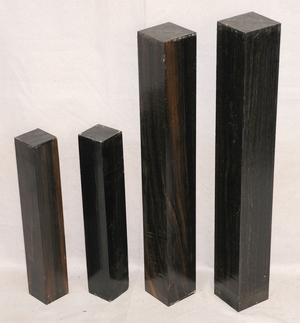
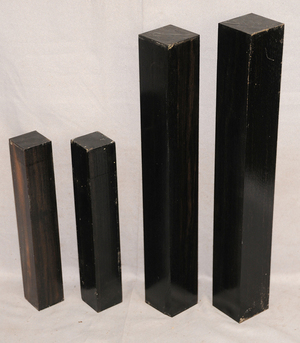
West African Ebony Turning Squares
Diospyros crassiflora
Sometimes called Gabon or Gaboon, this Ebony is sometimes jet black but oftentimes has grayish streaks that mostly disappear when finished or after the made object has been put into service. This Ebony has a marked resistance to checking that is characteristic of some of the Indian and Asian species. It has a wonderful texture and is easily carved, planed, turned, and milled. It is fairly fine-grained and takes a high polish. This Ebony usually originates in either Cameroon or Nigeria and the logs are rough hewn in the forest and oftentimes brought to the nearest road by human porters. With the disappearance of other species of black Ebony this species is fast becoming the Ebony of choice.
Item Number: W44327
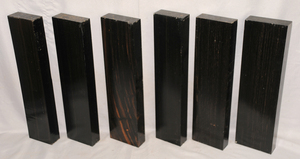
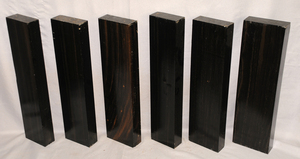
West African Ebony
Diospyros crassiflora
Sometimes called Gabon or Gaboon, this Ebony is sometimes jet black but oftentimes has grayish streaks that mostly disappear when finished or after the made object has been put into service. This Ebony has a marked resistance to checking that is characteristic of some of the Indian and Asian species. It has a wonderful texture and is easily carved, planed, turned, and milled. It is fairly fine-grained and takes a high polish. This Ebony usually originates in either Cameroon or Nigeria and the logs are rough hewn in the forest and oftentimes brought to the nearest road by human porters. With the disappearance of other species of black Ebony this species is fast becoming the Ebony of choice.
Item Number: W44325
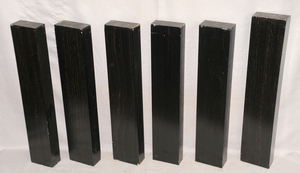
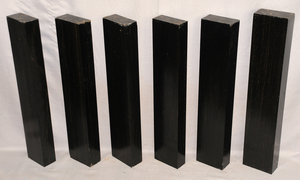
West African Ebony
Diospyros crassiflora
Sometimes called Gabon or Gaboon, this Ebony is sometimes jet black but oftentimes has grayish streaks that mostly disappear when finished or after the made object has been put into service. This Ebony has a marked resistance to checking that is characteristic of some of the Indian and Asian species. It has a wonderful texture and is easily carved, planed, turned, and milled. It is fairly fine-grained and takes a high polish. This Ebony usually originates in either Cameroon or Nigeria and the logs are rough hewn in the forest and oftentimes brought to the nearest road by human porters. With the disappearance of other species of black Ebony this species is fast becoming the Ebony of choice.
Item Number: W44324
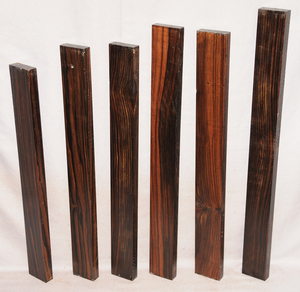
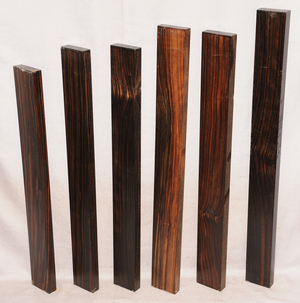
Macassar Ebony
Diospyros celebica
A classically striped Ebony from Asia. Quartersawn.
Item Number: W44323
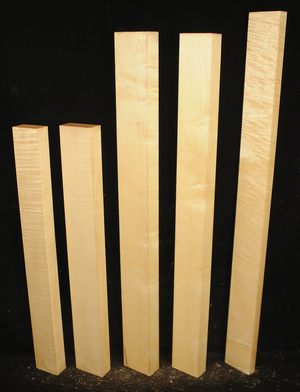
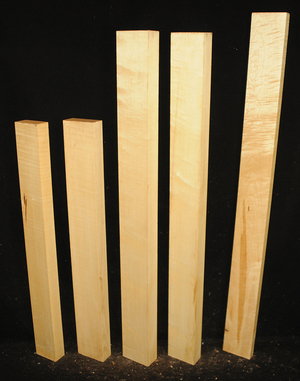
Figured European Sycamore
Acer pseudoplatanus
This European Maple is native to central Europe and west Asia. It is a tough, white or cream colored, fine-grained timber. It reminds me of vanilla ice cream because it is so even-colored. It works well in any grain direction. It is used for musical instruments, furniture, cabinetry, and because it is non-staining it is used for kitchen utensils, wooden spoons, rolling pins, and cutting boards. The figure is fiddleback on the quartersawn surface and more of a broken curl on the flatsawn surface. Select, quartersawn material is used for violin backs and sides and necks. Dry.
Item Number: W44319
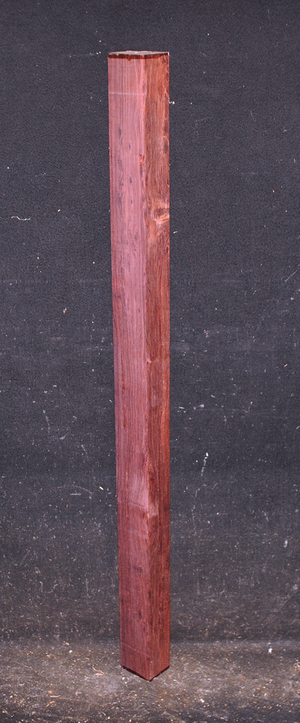
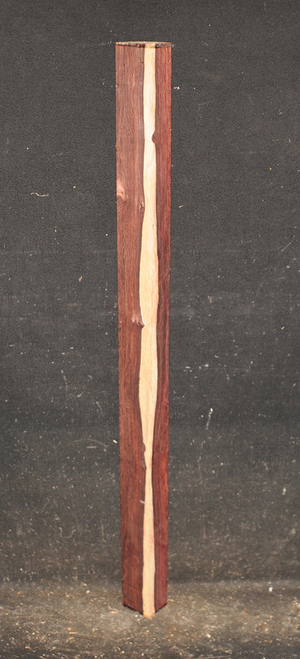
Camatillo
Dalbergia congestiflora
Also called Para Kingwood & Mexican Kingwood. The deep purple heartwood is oily and takes an incredible polish with a smoothness pleasing to the fingertips.
Due to CITES regulations, we can only ship this species to customers in the United States.
The board has an area that has some bird's-eye figure, which is rare in this species.
Item Number: W44318
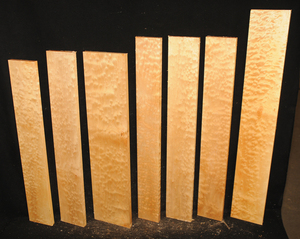
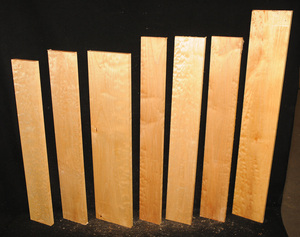
Quilted Big Leaf Maple
Acer macrophyllum
This tree is native to the Pacific Northwest. It has the distinction of having the largest leaf of the Maples-up to 15" in diameter. This is a soft Maple. The tree can produce many different types of figure, including quilted (tubular, popcorn, & cloud), curly (fiddleback, broken, & basketweave), and burl.
A, B, & E have pretty nice figure on both sides.
The other boards have nice figure on one face.
Item Number: W44317
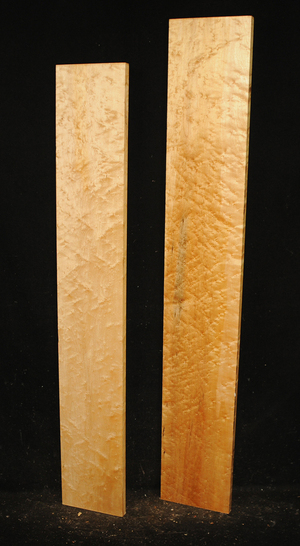
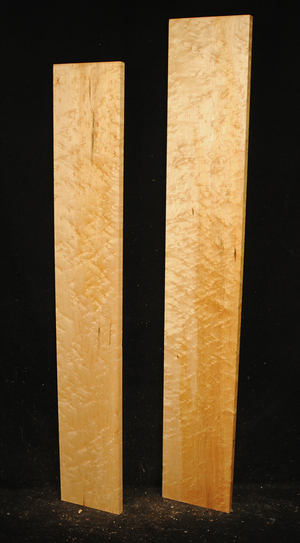
Bird's-eye Maple
Acer saccharum
The heartwood is white or cream to light brown or reddish brown. Figured somewhat like that of burl with many small eyes separate from each other. Hard and heavy, 45 lbs/cu ft. Easy to work and takes a smooth polish. U.S.A.
Item Number: W44313
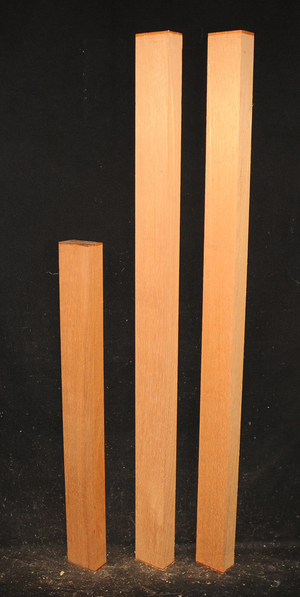
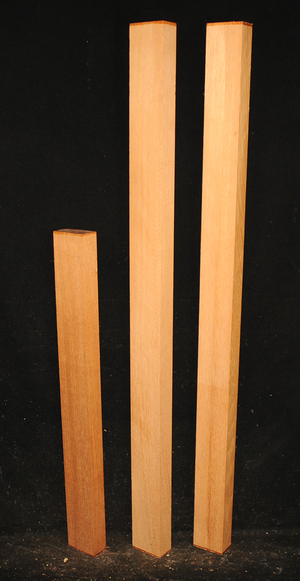
Spanish Cedar
Cedrela sp.
Also called Cigar Box Cedar because of its aromatic scent and its wide use in tobacco humidors. It resembles the wood of South American Mahogany to which it is related. Heartwood color varies from a light pinkish brown to reddish brown. It is fairly light in weight.
Due to CITES regulations, we can only ship this species to customers in the United States.
Item Number: W44312
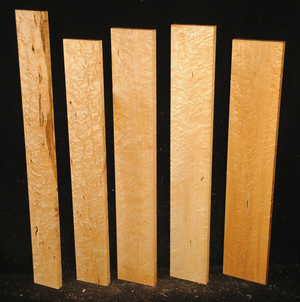
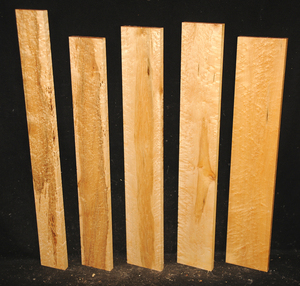
Bird's-eye Maple
Acer saccharum
The heartwood is white or cream to light brown or reddish brown. Figured somewhat like that of burl with many small eyes separate from each other. Hard and heavy, 45 lbs/cu ft. Easy to work and takes a smooth polish. U.S.A.
Item Number: W44311
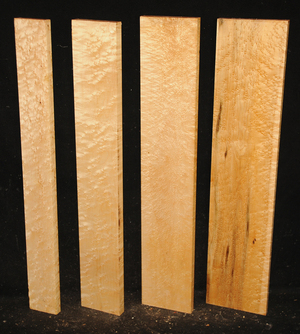
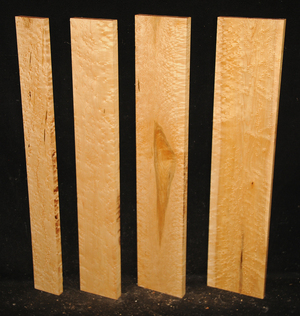
Bird's-eye Maple
Acer saccharum
The heartwood is white or cream to light brown or reddish brown. Figured somewhat like that of burl with many small eyes separate from each other. Hard and heavy, 45 lbs/cu ft. Easy to work and takes a smooth polish. U.S.A.
Item Number: W44310
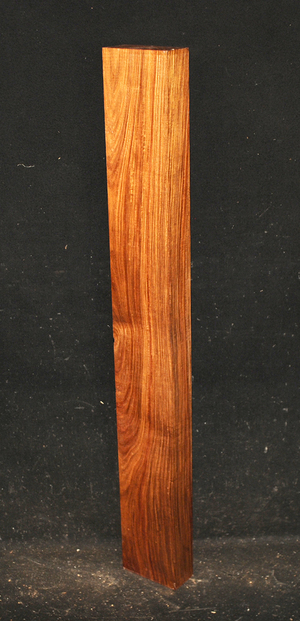
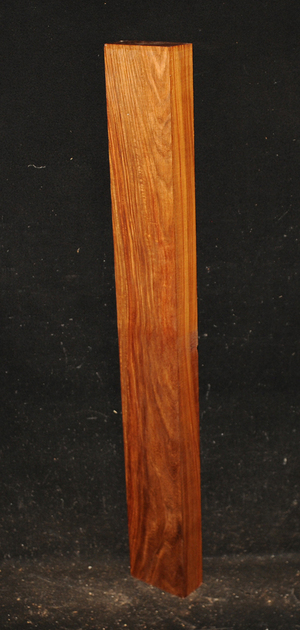
Narra
Pterocarpus indicus
Also called New Guinea Rosewood. It is a beautiful, highly lustrous golden yellow color sometimes with reddish streaks. A nice turning wood it is also used in furniture, jewelry boxes, handles, etc. It is easy to work and glue and takes a nice polish.
Item Number: W44306
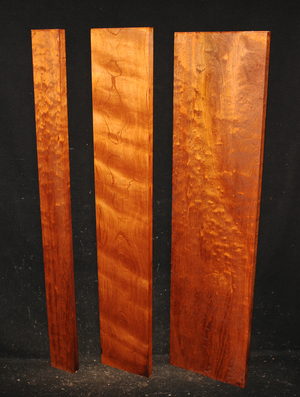
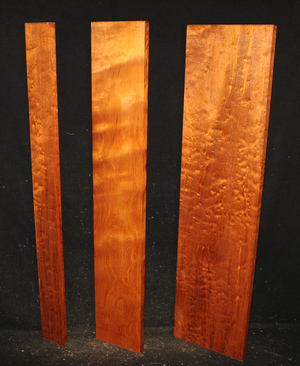
Figured Genuine Mahogany
Swietenia macrophylla
Also called Acajou, Tropical American Mahogany, and Honduras Mahogany. This medium to large tree occurs throughout Central and South America. Related to Cuban Mahogany (Swietenia mahogani) and Pacific Coast Mahogany (Swietenia humilis). It produces one of the classic furniture and cabinetmaking woods. The heartwood varies from a light reddish-brown to a rich, dark red. Generally straight grained and exceptionally stable, it is easy to machine, hand plane, sand and finish. Occasional logs produce several figures, curly, quilted, and the rare plum pudding figure which looks like large drips running down the board. Used in fine furniture and joinery, boat building, and in the guitar industry for acoustic sets and necks.
Due to CITES regulations, we can only ship this species to customers in the United States.
Item Number: W44303
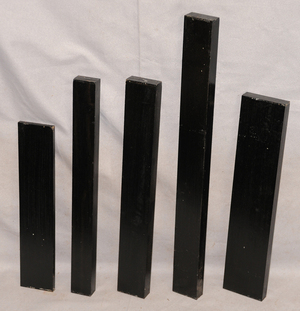
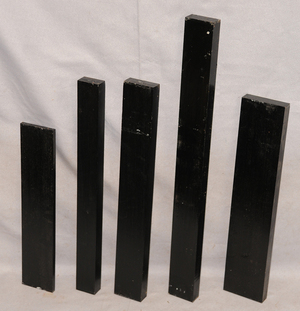
West African Ebony
Diospyros crassiflora
Sometimes called Gabon or Gaboon, this Ebony is sometimes jet black but oftentimes has grayish streaks that mostly disappear when finished or after the made object has been put into service. This Ebony has a marked resistance to checking that is characteristic of some of the Indian and Asian species. It has a wonderful texture and is easily carved, planed, turned, and milled. It is fairly fine-grained and takes a high polish. This Ebony usually originates in either Cameroon or Nigeria and the logs are rough hewn in the forest and oftentimes brought to the nearest road by human porters. With the disappearance of other species of black Ebony this species is fast becoming the Ebony of choice.
Item Number: W44301
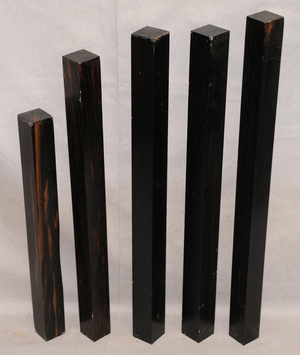
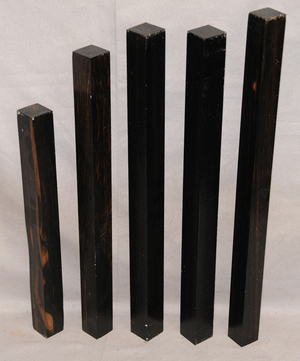
West African Ebony Turning Squares/Pool Cue Blanks
Diospyros crassiflora
Sometimes called Gabon or Gaboon, this Ebony is sometimes jet black but oftentimes has grayish streaks that mostly disappear when finished or after the made object has been put into service. This Ebony has a marked resistance to checking that is characteristic of some of the Indian and Asian species. It has a wonderful texture and is easily carved, planed, turned, and milled. It is fairly fine-grained and takes a high polish. This Ebony usually originates in either Cameroon or Nigeria and the logs are rough hewn in the forest and oftentimes brought to the nearest road by human porters. With the disappearance of other species of black Ebony this species is fast becoming the Ebony of choice.
Item Number: W44300